
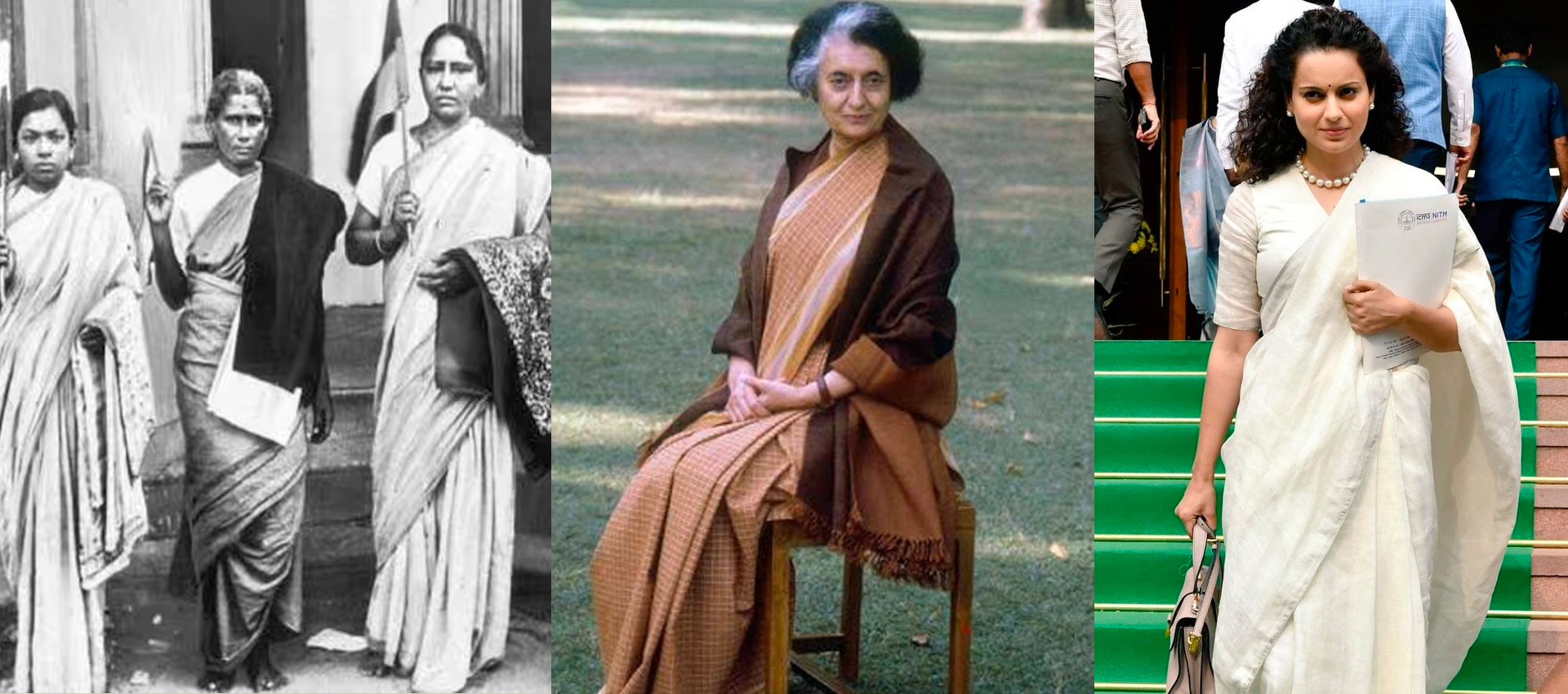
There is something quietly powerful about a saree.
It does not demand attention, yet it commands it. It does not shout authority, yet it often defines it. And nowhere is this more evident than in the world of Indian politics, where what a woman wears has never been just about fashion—it has always been about message, identity, and perception.
To understand this relationship, one has to travel back to pre-independence India, where clothing itself became an act of resistance. Women who stepped into public life during the freedom movement chose sarees not just out of tradition, but as a conscious political statement. Handspun fabrics, simple weaves, and understated drapes became symbols of self-reliance and unity.
The saree was no longer just a garment; it was a declaration of belonging to a larger cause. This early association created a lasting psychological imprint. The saree began to represent authenticity, relatability, and cultural rootedness—qualities that continue to shape public perception even today. Then came a defining shift with Indira Gandhi , a leader whose image remains etched in the collective memory of the nation. Her sarees were not extravagant, yet they carried unmistakable authority.
Crisp cottons, bold borders, and structured drapes became her signature. She did not need power dressing in the Western sense; her saree became her armor. What made this transformation remarkable was the subtlety. Without saying a word, her choice of attire communicated strength, discipline, and control. The saree, in her case, was no longer just about cultural identity—it became a symbol of leadership itself. But with time, the narrative began to evolve. As Indian politics entered a more media-driven era, the visual language of leadership started changing.
Public figures were no longer just leaders; they were constantly observed, analyzed, and interpreted. Every appearance, every outfit, every drape began to carry layered meanings. In this changing landscape, contemporary leaders like Smriti Irani present a different dimension of the saree’s role in politics. Her choices often balance tradition with accessibility. The sarees feel relatable, wearable, and grounded in everyday India.
This shift reflects a deeper change in political communication—the need to appear connected, approachable, and real. And this is where the saree reveals its true strength. Unlike many other forms of attire, it adapts. It evolves. It absorbs the personality of the wearer. The same six yards can represent resistance, authority, simplicity, or relatability, depending on who wears it and how. However, this relationship between politics and sarees is not without its complexities.
There is an unspoken expectation placed on women in power to “represent culture” through their clothing in ways that male counterparts are rarely expected to. The saree, while empowering, can also become a silent pressure—an unwritten rule of how a woman leader should present herself to be accepted or taken seriously. At times, this creates a narrow definition of authenticity. A woman in a saree is often perceived as more “grounded” or “Indian,” while those choosing other forms of attire may face unnecessary scrutiny.
This raises an important question—are we celebrating the saree, or are we limiting choice? Yet, despite these contradictions, the saree continues to hold its place. Because beyond politics, beyond perception, it carries something deeper. It carries familiarity. It carries memory. It carries a sense of home. For the public, seeing a woman in a saree often creates an immediate emotional connection. It feels known, understood, and trusted. And in politics, where trust is everything, this connection becomes incredibly powerful. This is perhaps why the saree has endured through decades of change.
From the freedom movement to the corridors of modern governance, it has remained relevant—not because it stayed the same, but because it adapted without losing its essence. For today’s woman, whether in politics or everyday life, the saree offers something rare. It allows her to define her own narrative.
To choose how she wants to be seen. To blend strength with grace, authority with authenticity.
At Antarang, we believe the saree is more than a garment. It is a voice. A reflection of identity that evolves with every generation while staying rooted in something timeless. Because the saree does not just dress a woman. It tells her story.
Explore sarees that celebrate identity, strength, and elegance at:
https://www.myantarang.com
image source : google

Real vs Fake Banarasi Saree: 9 Ways to Spot Authentic Handloom Weaving
September 17th, 2026
Jacquard Weaving Explained: Why Jacquard Does NOT Mean Powerloom
September 10th, 2026
The Origin of Linen Sarees in India: From Ancient Flax to Handloom
September 2nd, 2026

