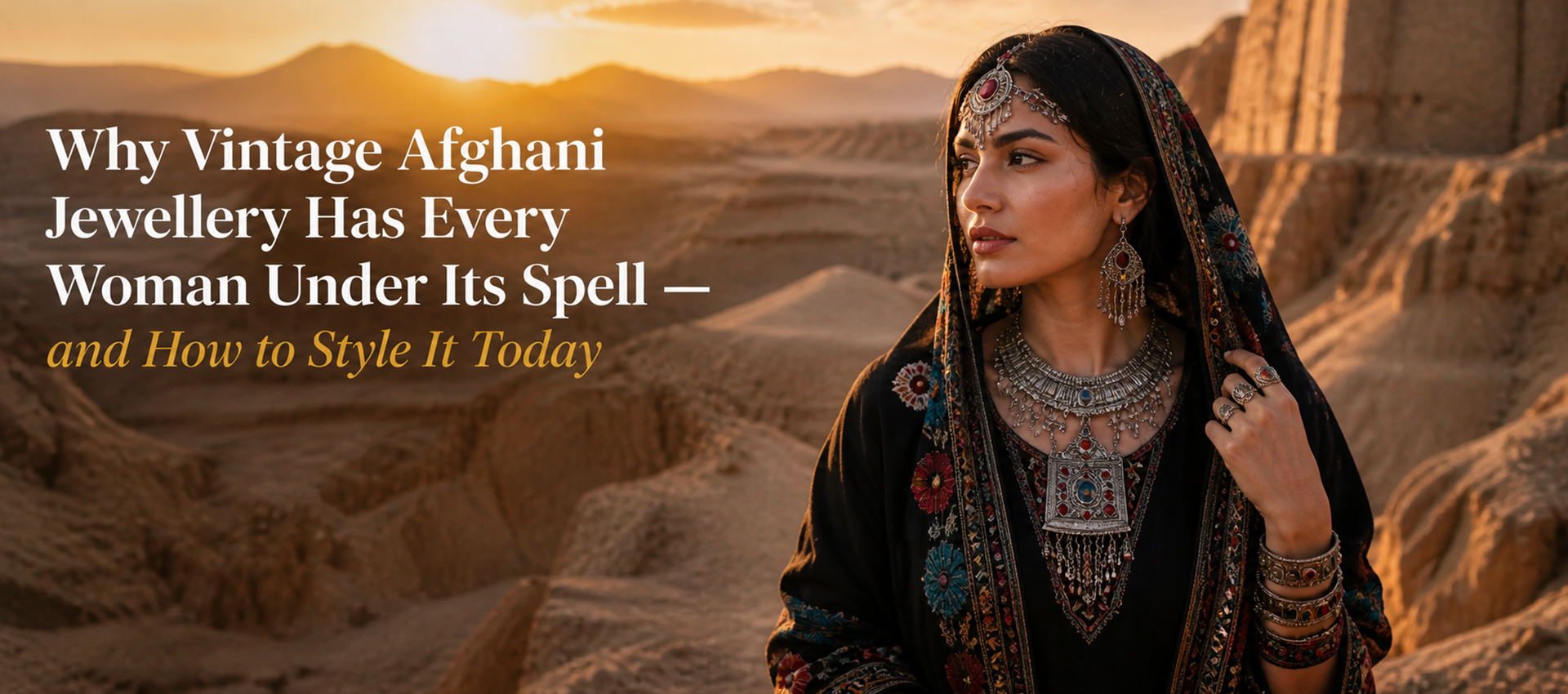
Why does Afghani jewellery make women stop scrolling, stop walking, stop breathing?
There is a specific kind of awe that happens when a woman first encounters a piece of authentic vintage Afghani jewellery. It is not gentle admiration. It is something closer to recognition — as if some ancient, pre-rational part of the brain says: this is power, and it belongs on a body.
Afghani jewellery is not designed to whisper. It is forged to declare. Crafted across centuries by the tribal communities of Afghanistan, Pakistan, and the broader Hindu Kush region — Kuchi nomads, Pashtun silversmiths, Hazara artisans — these pieces carry the accumulated aesthetic intelligence of cultures that had no access to industrial production but possessed an extraordinary mastery of metal, stone, and symbolism. The result is jewellery that is simultaneously raw and refined, ancient and arresting.
In an age of machine-stamped gold and generic mall jewellery, the irregularity of Afghani craft is its superpower. No two pieces are identical. Every hammer mark, every asymmetric setting, every slightly imperfect bezel is proof of human hands. And in 2025, that proof is the most luxurious thing you can wear.
The foundation of most authentic vintage Afghani jewellery is oxidised silver or white metal , often combined with an extraordinary cast of natural stones: deep blue lapis lazuli mined from Badakhshan's ancient mountains, blood-red carnelian from the Indus Valley trade routes, turquoise from the mines of Nishapur, coral brought in from the Arabian Sea, and occasionally raw amber or uncut garnets. Each stone was chosen not just for beauty but for meaning — lapis lazuli for protection and truth, turquoise to ward off the evil eye, carnelian for courage.
The metalwork techniques include repoussé (hammering designs from the reverse), granulation (tiny fused metal beads that create texture), filigree, chain-making, and a distinctive style of stone-setting where gems are held in thick, bold bezels that frame rather than diminish the stone. Many vintage pieces also incorporate enamel work, mirror-glass inserts, and dangling chains with coin-shaped pendants — each element adding sound and movement to the jewellery, turning the wearer into an experience rather than just an appearance.
The real reason women are obsessed — it is not just aesthetics Fashion psychologists have a term for what Afghani jewellery does: embodied history. When you wear a piece of vintage craft, your body becomes a site of cultural memory. You are not just accessorising — you are carrying forward a lineage. This creates a psychological sensation that mass-produced jewellery simply cannot replicate: the feeling of significance.
There is also the matter of presence. A large Afghani choker or a cascade of layered tribal necklaces changes how a woman moves through space. She becomes audible — the quiet jingle of metal-on-metal announces her arrival. She becomes visible — the scale and drama of the piece draw the eye before anything else does. For many women, wearing Afghani jewellery is the closest thing to armour that fashion offers. It does not make you look delicate. It makes you look formidable.
And then there is the Instagram effect. The high contrast of oxidised silver against dark skin, deep-toned sarees, and earthy handloom fabrics is visually extraordinary. Afghani jewellery photographs like nothing else — every post stops the thumb.
How to style vintage Afghani jewellery today —
six pairings that actually work The most common styling mistake with Afghani jewellery is over-thinking it. These pieces were designed to be worn by women who lived boldly — nomads, queens, traders. They do not require careful curation. They require confidence. Here are six modern pairings that let the jewellery do what it was always meant to do:
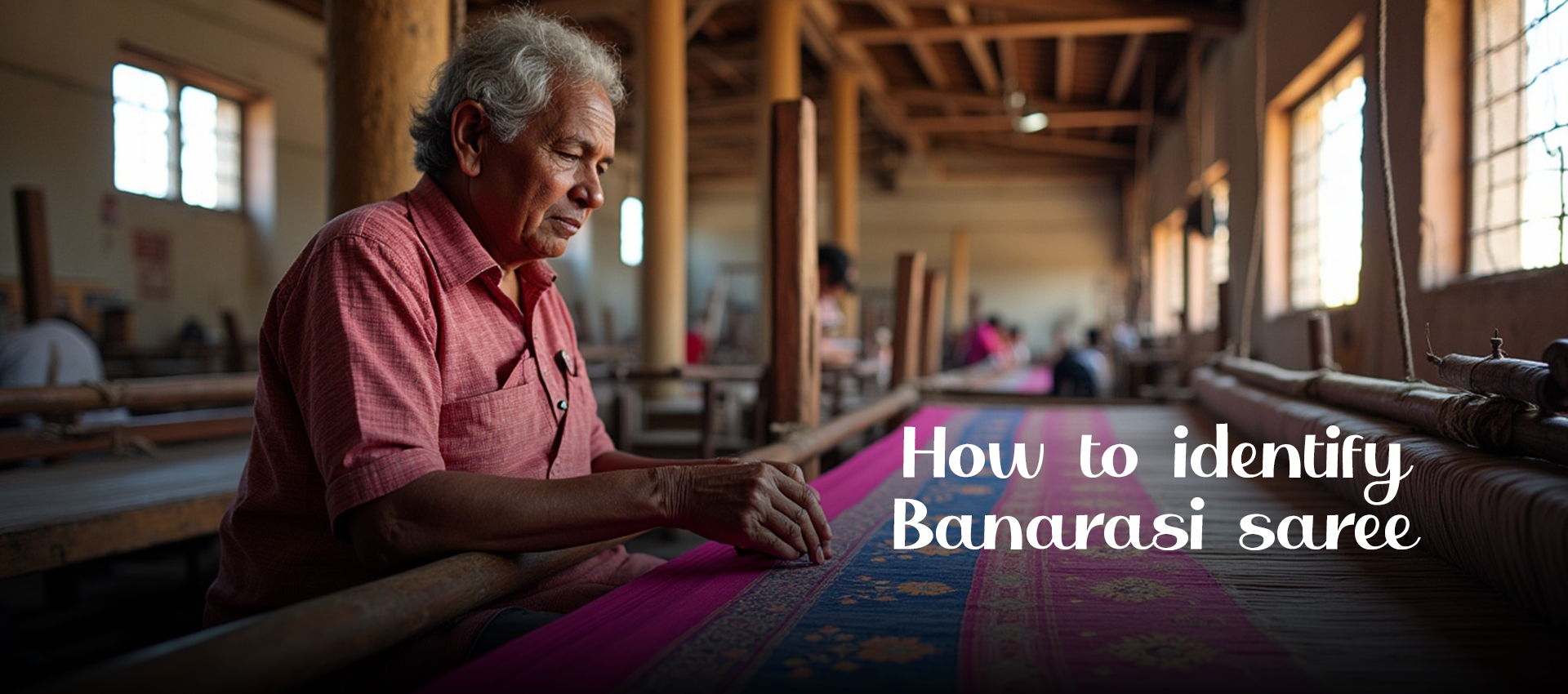
Real vs Fake Banarasi Saree: 9 Ways to Spot Authentic Handloom Weaving
September 17th, 2026
Jacquard Weaving Explained: Why Jacquard Does NOT Mean Powerloom
September 10th, 2026
The Origin of Linen Sarees in India: From Ancient Flax to Handloom
September 2nd, 2026