
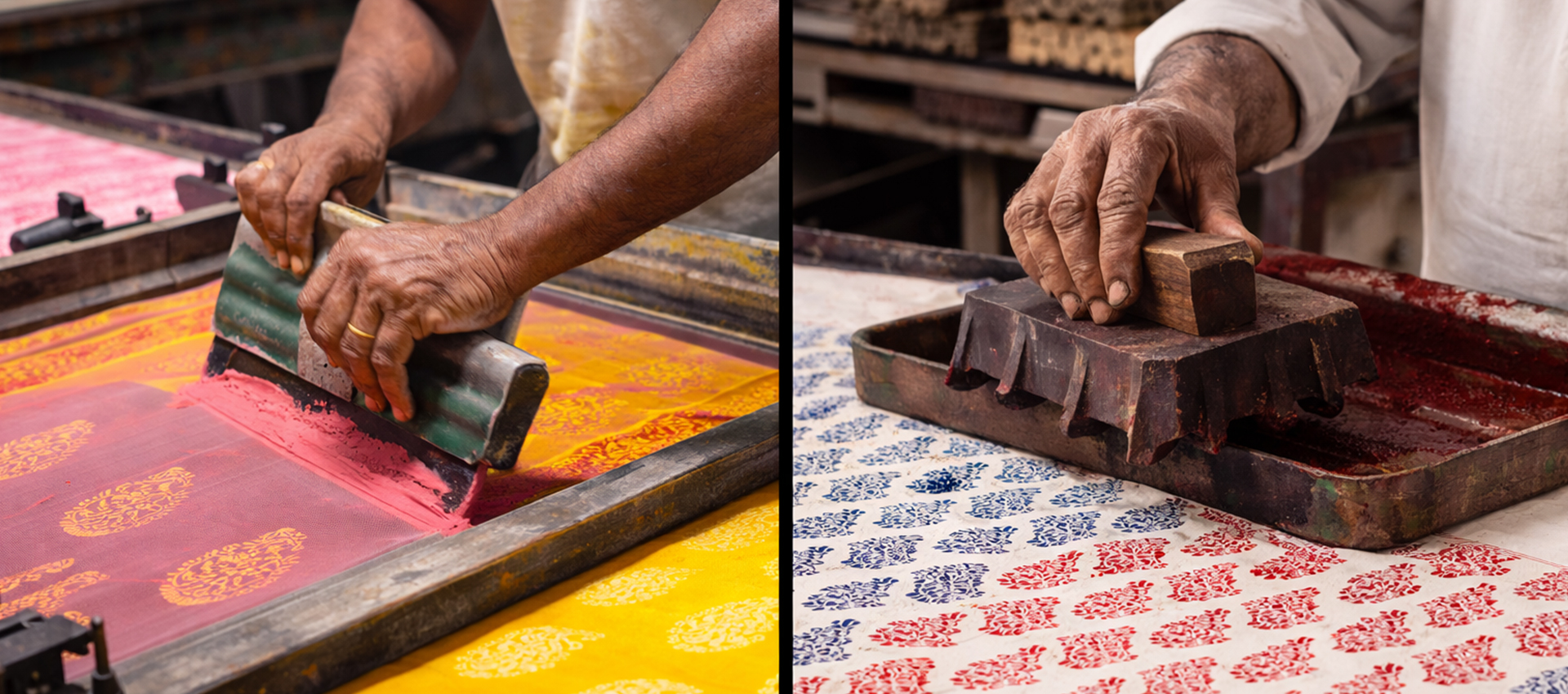
Few conversations in the textile world create as much debate as the comparison between screen printing and handblock printing. For many conscious shoppers and handloom lovers, the conversation often sounds like a battle. On one side stands handblock printing — celebrated as a centuries-old craft where artisans carve wooden blocks and stamp each motif carefully onto fabric. On the other side stands screen printing — efficient, scalable, and often criticized for being too mechanical or commercial.
But the truth behind this debate is far more complex than it appears.
Both techniques exist not because one defeated the other, but because each serves a different purpose in the textile ecosystem. Both generate employment, support livelihoods, and bring beautiful printed textiles to wardrobes across the country. The real question is not which one is better. The real question is whether we truly understand what we are buying.
Handblock printing carries the charm of imperfection. Every motif is stamped by hand using carved wooden blocks dipped in dye or pigment. Slight variations in alignment, pressure, and color density are not flaws — they are signatures of the human hand. These subtle inconsistencies are exactly what make handblock printed fabrics feel alive.
For generations, entire communities have depended on this craft. Skilled artisans spend years learning how to carve blocks, mix dyes, align patterns, and repeat intricate motifs across long lengths of fabric. Each piece requires patience, rhythm, and deep experience. The process is slow, deliberate, and deeply rooted in tradition.
Because of this, handblock printing naturally comes with limitations. It cannot be produced at the speed of large-scale manufacturing. Complex designs take time to execute. The production cost is higher because human skill is involved at every stage. For customers seeking affordable clothing or fast turnaround times, handblock printing may not always meet those expectations.
This is where screen printing enters the story.
Screen printing was developed to meet the growing demand for printed fabrics at scale. Using mesh screens and stencils, designs can be transferred onto fabric quickly and consistently. Large batches of fabric can be printed with identical patterns, making it easier for brands to produce garments in higher volumes.
While many people see screen printing as purely industrial, it also supports a large workforce. Skilled technicians prepare screens, mix colors, align layers, and manage printing tables. Entire printing units employ hundreds of workers whose livelihoods depend on this system. In other words, both techniques sustain communities. Yet the conversation around these two methods often becomes unnecessarily polarized.
Handblock printing is sometimes romanticized as the only “authentic” form of textile printing, while screen printing is dismissed as inferior or commercial. This perspective overlooks an important reality.
The textile industry is vast and diverse. Not every consumer can afford handcrafted textiles. Not every wardrobe requires heirloom pieces. For many people, screen printed fabrics provide accessible fashion that fits their lifestyle and budget. At the same time, handblock printing represents a craft heritage that deserves recognition and preservation. When customers consciously choose handblock printed textiles, they are supporting a slower and more skilled form of production that keeps traditional crafts alive. The problem arises when consumers are misled.
One of the biggest challenges today is transparency. In many cases, screen printed fabrics are marketed as handblock prints simply because the designs look similar. Without knowledge of the differences, buyers may believe they are purchasing handcrafted textiles when they are actually buying machine-assisted prints. This is where awareness becomes powerful.
When customers understand how a fabric is made, they gain the ability to make informed choices. They can decide whether they want the uniqueness of a handblock printed textile or the affordability and consistency of a screen printed one.
Neither choice is wrong. The real mistake is buying something without knowing its story.
Interestingly, many experienced textile lovers begin to appreciate both techniques over time. They may choose handblock printed fabrics for special pieces that celebrate craftsmanship, while also enjoying screen printed textiles for everyday wear.
This balanced perspective reflects the reality of modern fashion. In the end, the debate between screen print and handblock print should not be about declaring a winner. It should be about understanding the value each technique brings to the textile world. One represents heritage, patience, and artistry.
The other represents accessibility, scale, and practicality. Both support livelihoods. Both create opportunities for workers. Both bring beauty to fabric. The real power lies with the buyer — the person who decides what kind of story they want their clothing to tell. Because when you know what you are buying, every choice becomes meaningful.
At Antarang, we celebrate the beauty of handcrafted textiles while also encouraging conscious awareness about fabrics and craftsmanship. Our collections are thoughtfully curated to help you discover textiles that carry authenticity, comfort, and timeless elegance be it hand block or screen print.
Explore handcrafted sarees and fabrics at:
https://www.myantarang.com

Real vs Fake Banarasi Saree: 9 Ways to Spot Authentic Handloom Weaving
September 17th, 2026
Jacquard Weaving Explained: Why Jacquard Does NOT Mean Powerloom
September 10th, 2026
The Origin of Linen Sarees in India: From Ancient Flax to Handloom
September 2nd, 2026

