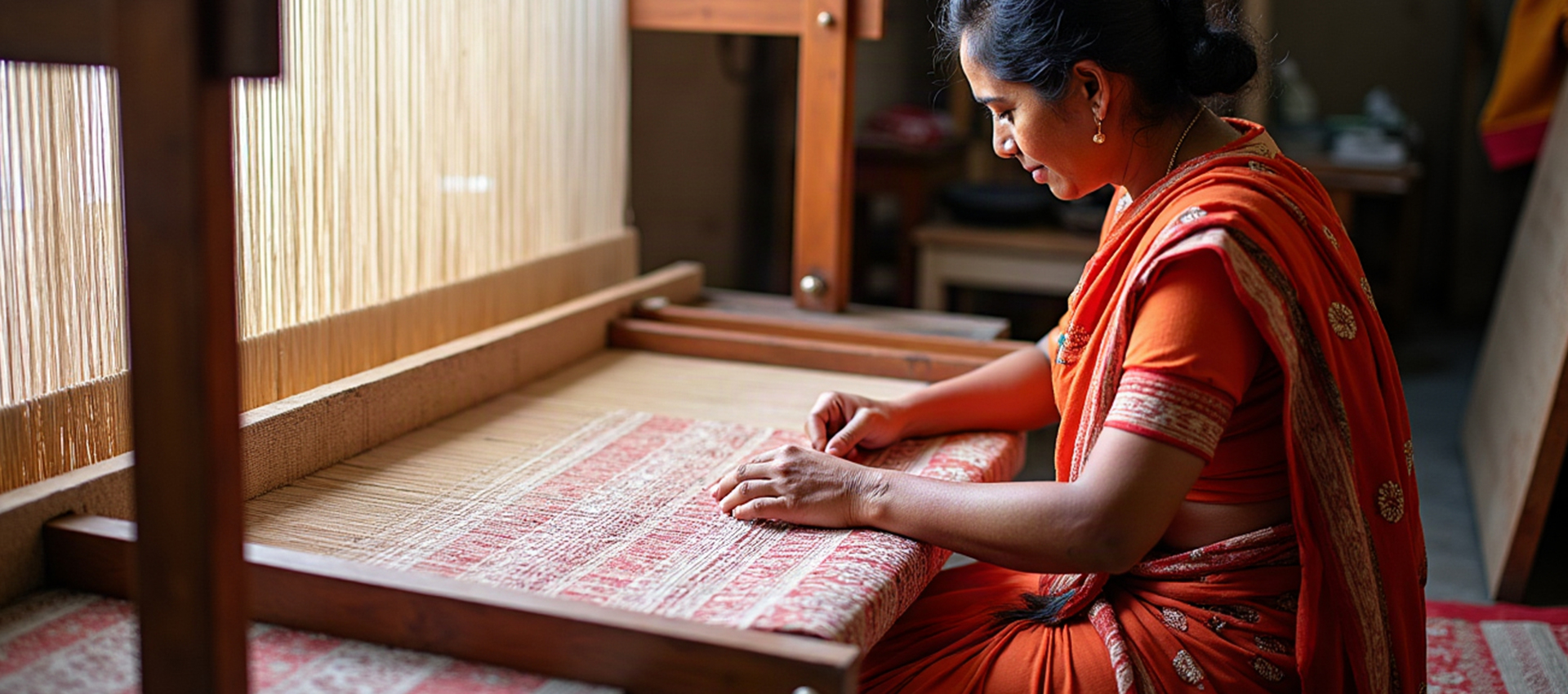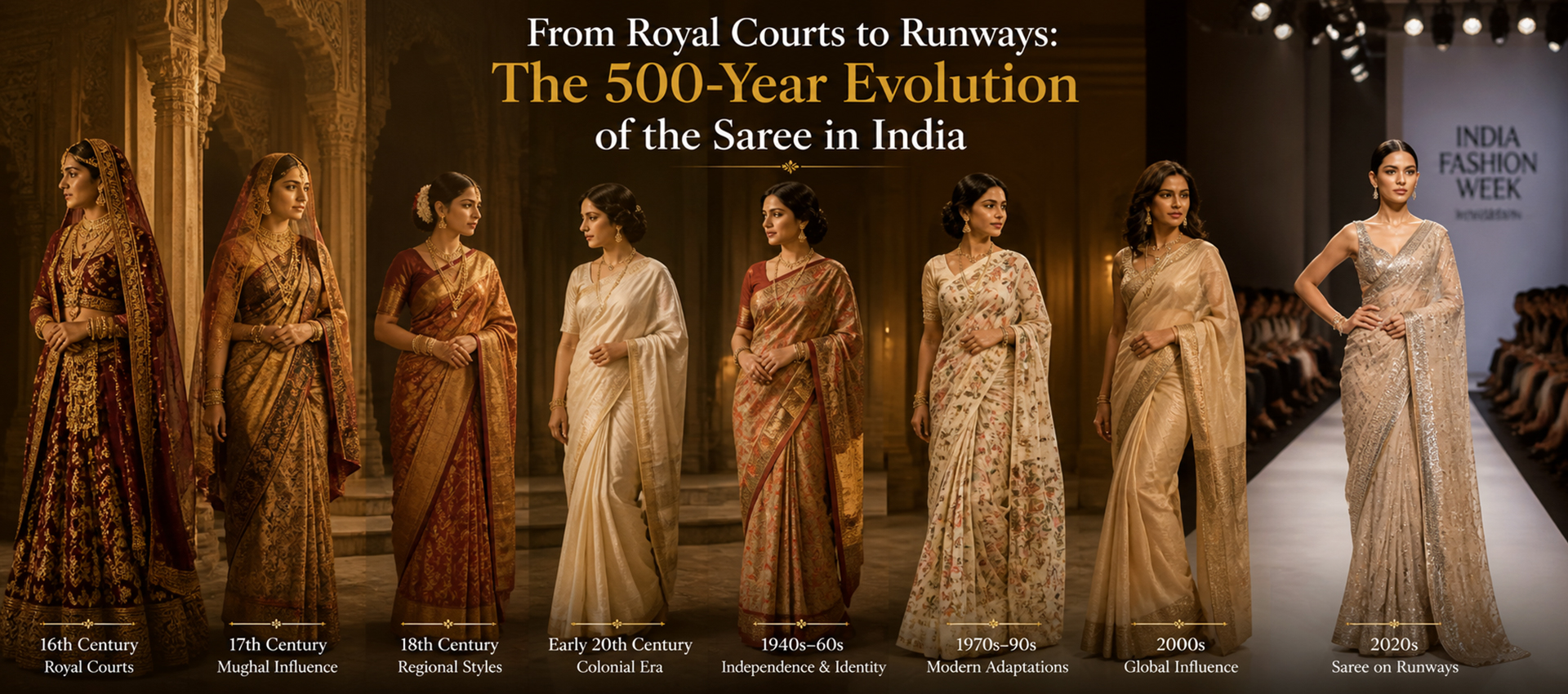
The Mughal era: when the saree met gold thread and Persian grandeur Before the Mughals arrived, Indian women had worn unstitched draped garments for centuries — but it was the Mughal courts of the 16th and 17th centuries that transformed the saree into an object of astounding opulence. Emperor Akbar's royal workshops, known as karkhanas, employed thousands of weavers who were tasked with producing textiles that could rival Persian and Central Asian luxury fabrics — but with an unmistakably Indian soul.
The result was the Mughal brocade tradition — rich silk sarees interwoven with real gold and silver zari thread, featuring intricate floral and geometric motifs drawn from Persian garden imagery. Benares (Varanasi) rose to pre-eminence as the centre of zari weaving, a status it holds to this day. Court paintings from the period depict noblewomen in diaphanous muslin sarees so fine they were nicknamed "woven air" (woven air — baft hawa) and "running water." These were not garments. They were power draped in silk.
The age of regional weaves: how every kingdom created its own identity in cloth As Mughal power gradually fragmented and regional kingdoms — the Marathas, the Nizam of Hyderabad, the Vijayanagara successors, and the courts of Mysore and Travancore — consolidated their own identities, each developed a distinctive saree tradition that became a marker of cultural pride.
The Kanjeevaram silk saree emerged from Tamil Nadu's temple towns, its heavy pure silk and contrasting borders inspired by the colours of temple gopurams. In Odisha, the Sambhalpuri tradition of ikat weaving — where threads are tie-dyed before being placed on the loom, creating patterns that bloom from within the fabric — reached its highest form. Maharashtra's Paithani sarees, woven with peacock and lotus motifs in fine silk and gold, became the most coveted wedding textile of the Deccan. Each of these traditions was not just aesthetic — it was a form of political and cultural sovereignty. To wear a Paithani was to declare yourself Maratha. To drape a Kanjivaram was to announce your allegiance to a civilisation.
The colonial wound: how British textile policy nearly killed India's weaving soul The arrival of British colonial rule — and specifically the imposition of British textile imports — was catastrophic for India's weaving communities. By the mid-19th century, Manchester mill-produced cotton was being dumped into Indian markets at prices that handloom weavers simply could not compete with. Entire weaving villages in Bengal, Bihar, and Andhra were devastated. The legendary Dhaka muslin weavers, who had produced the finest fabric in human history for the Mughal courts, all but disappeared.
And yet, the saree endured — and became something more. By the late 1800s, the saree had transformed into a symbol of resistance. Swadeshi activists began wearing handloom sarees as a deliberate political act — choosing Indian craft over British import. Rabindranath Tagore was instrumental in promoting Bengali handloom sarees as an act of cultural pride. The garment that colonialism tried to replace with factory cloth became, paradoxically, the most potent symbol of the freedom movement.
Khadi, Congress, and the saree as a political uniform Mahatma Gandhi's call for Swadeshi — the embrace of homespun, locally made goods — gave the saree a new identity as a garment of moral conviction. The khadi saree became the unofficial uniform of India's independence movement. Women who joined the freedom struggle — Sarojini Naidu, Kasturba Gandhi, Kamala Nehru — wore simple cotton or khadi sarees not just as practical clothing but as a deliberate rejection of colonial aesthetics.
This era also saw a significant shift in how the saree was draped. The Nivi style — originating from Andhra Pradesh and brought to national prominence by the women of the nationalist movement — became the dominant draping style across India, largely displacing the more region-specific styles that had prevailed before. The Nivi drape was practical, elegant, and distinctly anti-colonial in its simplicity. It is the style that most Indian women — and the world — recognise as "the saree" today.
Post-independence: the saree becomes the nation's sartorial ambassador In the decades following independence, the saree took on a new role: national ambassador. Indira Gandhi wore handloom sarees — often from weaving cooperatives she actively patronised — to every world stage, making the garment synonymous with Indian statesmanship. The state-owned Cottage Industries Emporium and later the Handloom Board worked to promote regional weaves to urban consumers and the global diaspora.
The 1960s and 70s brought Bollywood's golden influence — actresses like Nargis, Waheeda Rehman, and later Rekha and Hema Malini made the saree a vehicle for glamour, drama, and desire. Designers like Ritu Kumar began bridging the gap between craft tradition and contemporary fashion, bringing handloom and block-print sarees to boutiques and fashion weeks. By the 1980s, the saree was being reframed — from "what Indian women wear" to "what Indian design looks like."
The Instagram revolution: how the saree found its most passionate generation yet The 2010s brought something no one fully anticipated: the internet gave the saree its most passionate revival in a century. Instagram, in particular, became a powerful stage for saree lovers, weavers, and small businesses to connect directly — bypassing the middlemen who had historically marginalised artisans from the value their work created.
Brands like Antarang were born in this moment — built on Instagram, grounded in direct relationships with master weavers, and driven by a belief that the modern Indian woman did not want to choose between her heritage and her aesthetic sensibility. The "saree not sorry" movement normalised wearing the saree to workplaces, cafes, airports, and even protests. For a generation raised on global fashion, the handloom saree became the ultimate slow-fashion statement — ethically made, culturally rich, and utterly irreplaceable by any machine-made alternative.
Today, GI-tagged weaves like Chanderi, Kota Doria, and Sambhalpuri are selling internationally. Young weavers are using digital platforms to market their own work. And a woman in Gurgaon can wear a saree woven three weeks ago in a village in Madhya Pradesh — knowing exactly who made it, and why it matters.
Five hundred years of invasions, revolutions, colonial violence, and digital disruption — and the saree is still here. Not despite history, but because of it. Every thread carries memory. Every drape, a decision. The saree does not just survive change. It becomes it.
At Antarang, we are proud to carry forward this living tradition — sourcing directly from master weavers across India, one handcrafted saree at a time. Each piece in our collection is a chapter in this 500-year story
Wear the story — explore our collection →
11 Fascinating Facts About Banarasi Sarees You Probably Never Knew
September 24th, 2026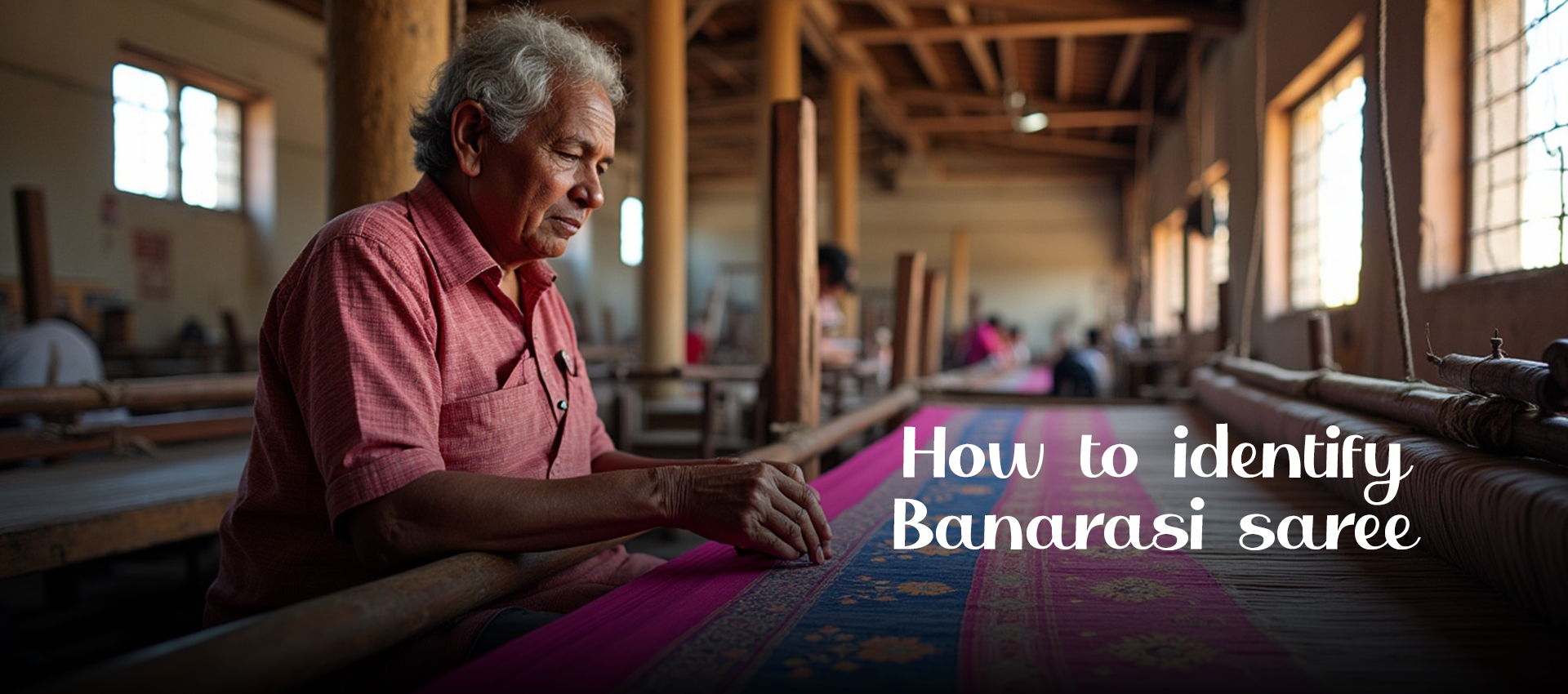
Real vs Fake Banarasi Saree: 9 Ways to Spot Authentic Handloom Weaving
September 17th, 2026
Jacquard Weaving Explained: Why Jacquard Does NOT Mean Powerloom
September 10th, 2026
The Origin of Linen Sarees in India: From Ancient Flax to Handloom
September 2nd, 2026