The deception hiding in plain sight
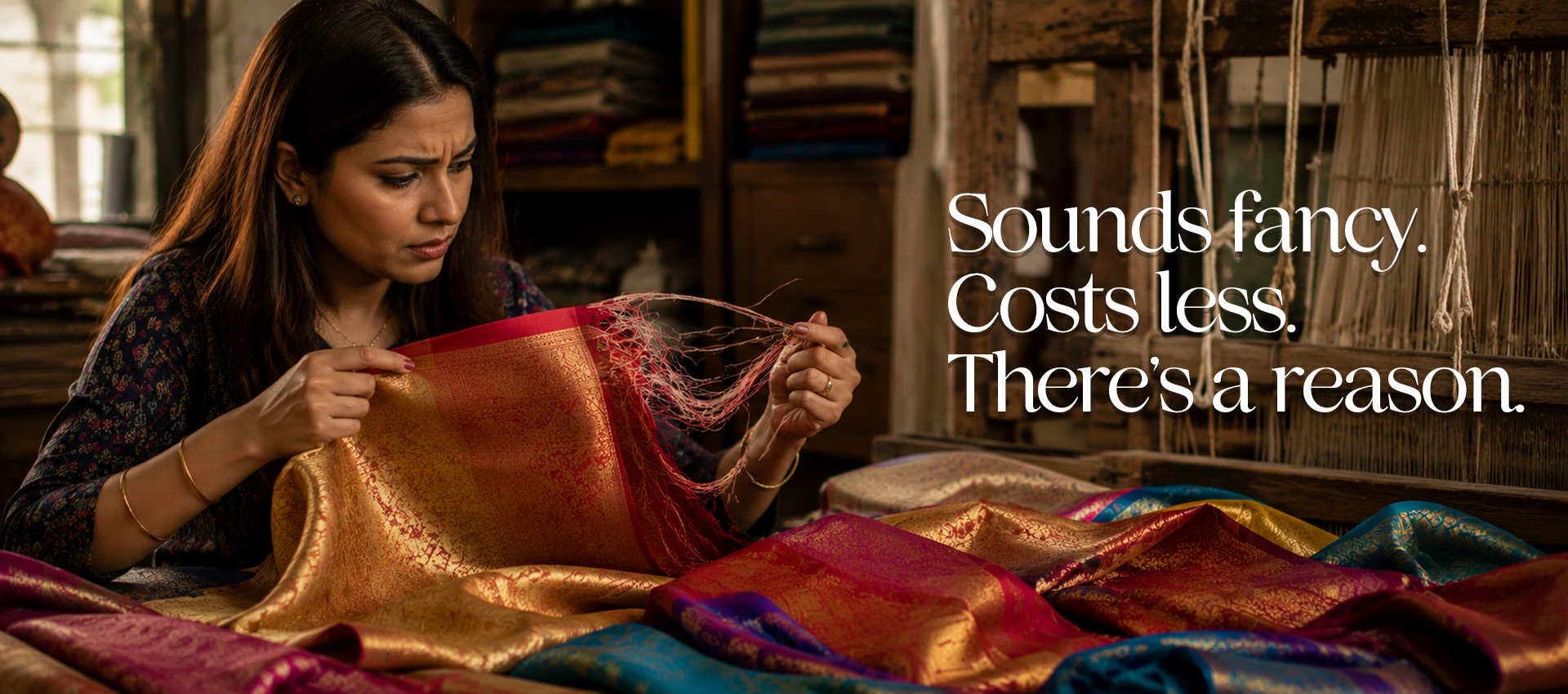
India's handloom and silk saree market is worth tens of thousands of crores annually, and it has attracted a shadow industry of extraordinary ingenuity and moral emptiness. Across wholesale markets, Instagram shops, exhibition stalls, and even physical retail stores, synthetic and semi-synthetic fabrics are being sold under the names of India's most celebrated textile traditions — Kanjivaram, Banarasi, Chanderi, Paithani, Tussar, Mysore silk — at price points designed to feel like a deal without triggering the scepticism that would accompany a genuinely suspicious price.
The buyers being targeted are not uninformed. They are saree lovers — women who care about what they wear, who have read about Indian textile traditions, who follow craft accounts on Instagram and believe in supporting artisans. The deception works precisely because it is aimed at people who know enough to ask for the right names but not yet enough to verify what they are actually receiving. Understanding this fraud is not just a matter of consumer protection. It is a matter of justice — for the master weavers whose livelihoods are being undercut by every fake piece that sells in their name.
The lexicon of deception: fancy names for cheap substitutes
The first tool in the fraudulent seller's kit is language. A vocabulary of misleading nomenclature has evolved specifically to bridge the gap between what a buyer wants and what they are actually receiving — terms that sound legitimate, evoke authentic craft traditions, and are technically impossible to prosecute because they are vague enough to mean almost anything.
"Art silk" is perhaps the most widespread example. The term sounds elevated — the word "art" evokes craft, intentionality, human skill. In reality, art silk is viscose rayon — a semi-synthetic material made from chemically processed wood pulp that has been used as a cheap silk substitute since the early 20th century. It mimics silk's sheen visually but has none of its strength, breathability, or longevity. It weakens dramatically when wet, loses its lustre rapidly with washing, and pills and frays within a fraction of the lifespan of genuine silk. A saree labelled "art silk Kanjivaram" or "art silk Banarasi" is neither Kanjivaram nor Banarasi — it is a viscose saree given a famous name to justify a higher price than its materials deserve.
"Satin silk" is another term that appears with alarming frequency in online and physical retail. Satin is a weave structure, not a fibre — it can be woven in genuine silk, in polyester, or in any number of other materials. When a seller describes a saree as "satin silk" without specifying the fibre content, they are almost always selling polyester satin — a fabric that has the visual sheen of silk from a distance but the texture, weight, and breathability of plastic. Polyester traps heat against the body, does not absorb perspiration, and in India's climate produces genuine physical discomfort in a way that no natural fibre ever does.
"Soft silk" is a term that has gained traction specifically in the Kanjivaram saree market, where it is used to describe sarees made from a blend of synthetic threads and a small percentage of silk — sometimes as little as 5 to 10 percent — that technically allows the seller to use the word "silk" without technically lying. The resulting fabric is softer and more drapeable than pure Kanjivaram silk, which gives it surface appeal, particularly to buyers unfamiliar with the characteristic stiffness of genuine Kanjivaram. The problem is that soft silk sarees age poorly, cannot be repaired by traditional weavers, and carry none of the investment value of a genuine piece.
"Organza silk," "tissue silk," "crepe silk," and "georgette silk" are all category names that in authentic versions describe specific weave structures executed in genuine silk — but in the fraudulent market are routinely applied to fully synthetic fabrics woven to resemble these structures. A genuine silk organza saree and a polyester organza saree can appear nearly identical in a photograph and similar enough to the untrained touch to pass inspection at a market stall. Their price, longevity, and wearability are entirely different.
The lexicon of deception: fancy names for cheap substitutes The first tool in the fraudulent seller's kit is language. A vocabulary of misleading nomenclature has evolved specifically to bridge the gap between what a buyer wants and what they are actually receiving — terms that sound legitimate, evoke authentic craft traditions, and are technically impossible to prosecute because they are vague enough to mean almost anything.
What synthetic threads actually are — and why they cannot replicate silk
Understanding why synthetic substitutes fall short requires a basic understanding of what makes genuine silk exceptional in the first place. Silk is a protein fibre — produced by the Bombyx mori silkworm as a continuous filament of fibroin protein coated in sericin gum. This protein structure gives silk its remarkable properties: it is naturally temperature-regulating, absorbing heat in cold conditions and wicking moisture in warmth. It is extraordinarily strong for its weight. It takes dye at a molecular level, producing colours of depth and complexity that synthetic fibres simply cannot replicate. And it ages with grace — genuine silk sarees, properly cared for, become more beautiful over decades, developing a patina and softness that new silk does not possess.
Polyester — the most common synthetic substitute — is made from petroleum-derived plastic polymers extruded into fine threads. It mimics silk's visual sheen through a surface-level optical trick rather than any structural similarity. It does not breathe, does not absorb moisture, does not regulate temperature, and does not age gracefully. Polyester fibres, examined under magnification, are perfectly cylindrical and uniform — entirely unlike the irregular, triangular cross-section of genuine silk filaments, which is precisely what produces silk's characteristic light-diffusing shimmer.
Viscose rayon, while derived from natural cellulose, undergoes such aggressive chemical processing that it loses most of the properties that make natural fibres desirable. It wrinkles badly, weakens when wet, and has a significantly shorter useful life than either cotton or genuine silk. The "natural origin" of viscose is a marketing talking point, not a meaningful indicator of quality or sustainability.
"A synthetic saree sold under the name of a handloom tradition does two kinds of damage simultaneously: it deceives the buyer and it devalues the weaver. Both are forms of theft."
The five tests every buyer should know before purchasing
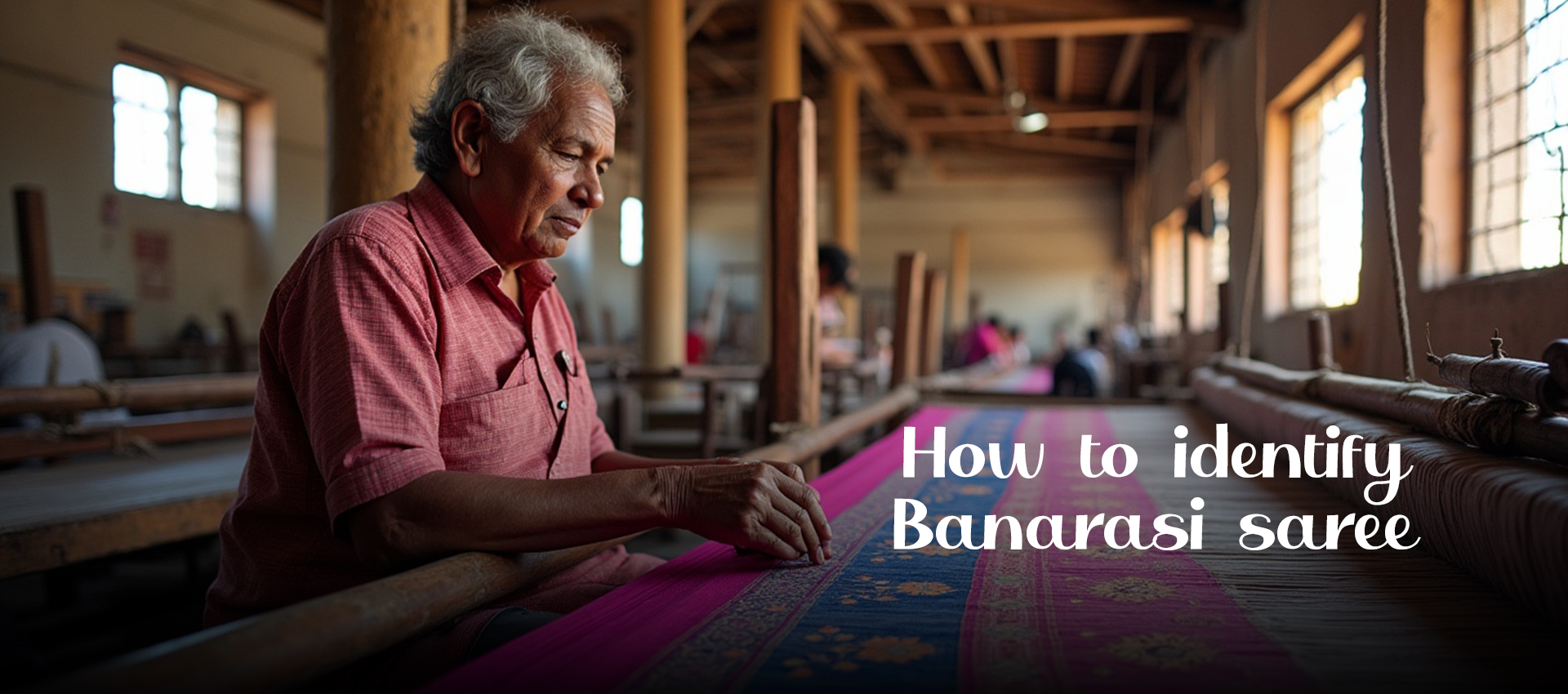
The good news is that genuine silk and quality handloom fabrics have physical properties that can be verified — not perfectly in every situation, but with enough reliability to significantly reduce the risk of being deceived. Here are the five tests that experienced saree buyers and textile traders use.
The burn test is the most definitive. A few threads pulled from a saree and held to a flame will reveal their fibre content clearly. Genuine silk burns slowly, curls away from the flame, produces a dark ash that crumbles easily, and smells distinctly of burning hair or protein — because it is a protein fibre. Polyester melts rather than burns, produces a hard plastic bead at the end of the thread, and smells of burning plastic. Viscose burns quickly and completely, like paper, with a smell of burning wood or cellulose. This test cannot be performed in a shop, but it should be the first thing you do when you bring home any expensive saree purchase you are uncertain about.
The weight test is useful in-store. Genuine silk is heavier than it appears — a full-length pure silk saree of six metres will feel substantial in the hand. Polyester and viscose sarees of the same apparent volume will feel noticeably lighter, because synthetic fibres are less dense than silk protein filaments. If a "silk" saree feels surprisingly light for its size, treat that as a significant warning signal.
The crush test assesses recovery. Scrunch a section of the saree firmly in your fist, hold for five seconds, and release. Genuine silk recovers its shape almost immediately — the protein fibre has natural resilience. Polyester also recovers quickly, which is why this test must be used alongside others. Viscose and art silk recover slowly and may retain visible crease marks — a reliable indicator that the fabric is not what it is claimed to be.
The zari test applies specifically to sarees claiming to have genuine gold or silver zari borders and motifs. Real zari — silver wire coated in gold — has a warm, deep lustre that does not flash or glitter under light. Synthetic metallic thread, which is simply metallic-coated polyester, has a sharper, more mirror-like glitter that catches light harshly. Rub the zari border gently between your fingers — genuine zari will retain its surface, while low-quality synthetic zari often begins to separate or peel with friction over time.
The price and provenance test is ultimately the most reliable guide for online purchases where physical examination is not possible. Always ask the seller directly: what is the fibre content? What is the weave origin? Who are the weavers? A seller who cannot or will not answer these questions clearly is not a seller you should trust with your money. Brands that source directly from verified weaving clusters — like Antarang — can trace every piece to its origin and will always be transparent about exactly what you are buying.
What to look for on labels: In India, the Handloom Mark and Silk Mark certifications are government-backed quality assurances — the Silk Mark specifically certifies that a product contains pure natural silk. Look for these marks when buying from physical retailers. Online, always ask for the certification or weaver source before purchasing any saree priced at a level that implies genuine handloom silk.
Why this matters beyond your wardrobe
The fraud in India's textile market is not a victimless crime of minor inconvenience to disappointed buyers. It is an economic attack on one of the country's most culturally significant and socially valuable industries. Every synthetic saree sold under the name of a genuine handloom tradition displaces a sale that should have reached a master weaver and their family. Every buyer deceived into purchasing "art silk Kanjivaram" is a buyer who was willing to spend money on authentic craft and was robbed of that choice by a seller who understood their intention and exploited it.
The handloom sector supports over seven million livelihoods across India, most of them in rural communities with limited alternative employment. The competition from fraudulently labelled synthetic substitutes is not just unfair — it is existential for weaving families who have spent generations cultivating skills that take years to acquire and cannot be automated. When you buy authentic handloom, you are not paying a premium for sentimentality. You are participating in an economy of genuine value — one where the price reflects actual human skill, actual time, and actual material quality rather than the cost of petroleum-derived plastic threads and clever marketing language.
At Antarang, our commitment is simple: every piece we sell is what we say it is. We know our weavers by name. We know their villages, their looms, their techniques. We can tell you exactly what fibre is in the saree you are considering, exactly who made it, and exactly how long it took. That transparency is not a selling point — it is the minimum standard of honesty that every buyer deserves and that every genuine artisan has earned.
At Antarang, every saree is sourced directly from verified master weavers. We never use misleading names, blended synthetics passed off as pure, or fabricated provenance. What we say is in the saree is in the saree — always.
Shop honestly sourced sarees at Antarang →