Cotton sarees for the workplace: authority without effort
The workplace is where cotton sarees have always had their strongest foothold — and for entirely practical reasons. Cotton breathes in air-conditioned offices and humid commutes with equal competence, requiring no special management through a long working day. It does not attract static, does not wrinkle in a way that looks unprofessional by mid-morning, and does not demand the same level of physical care that silk requires in a day that involves sitting, moving, and functioning as a professional rather than an aesthete.
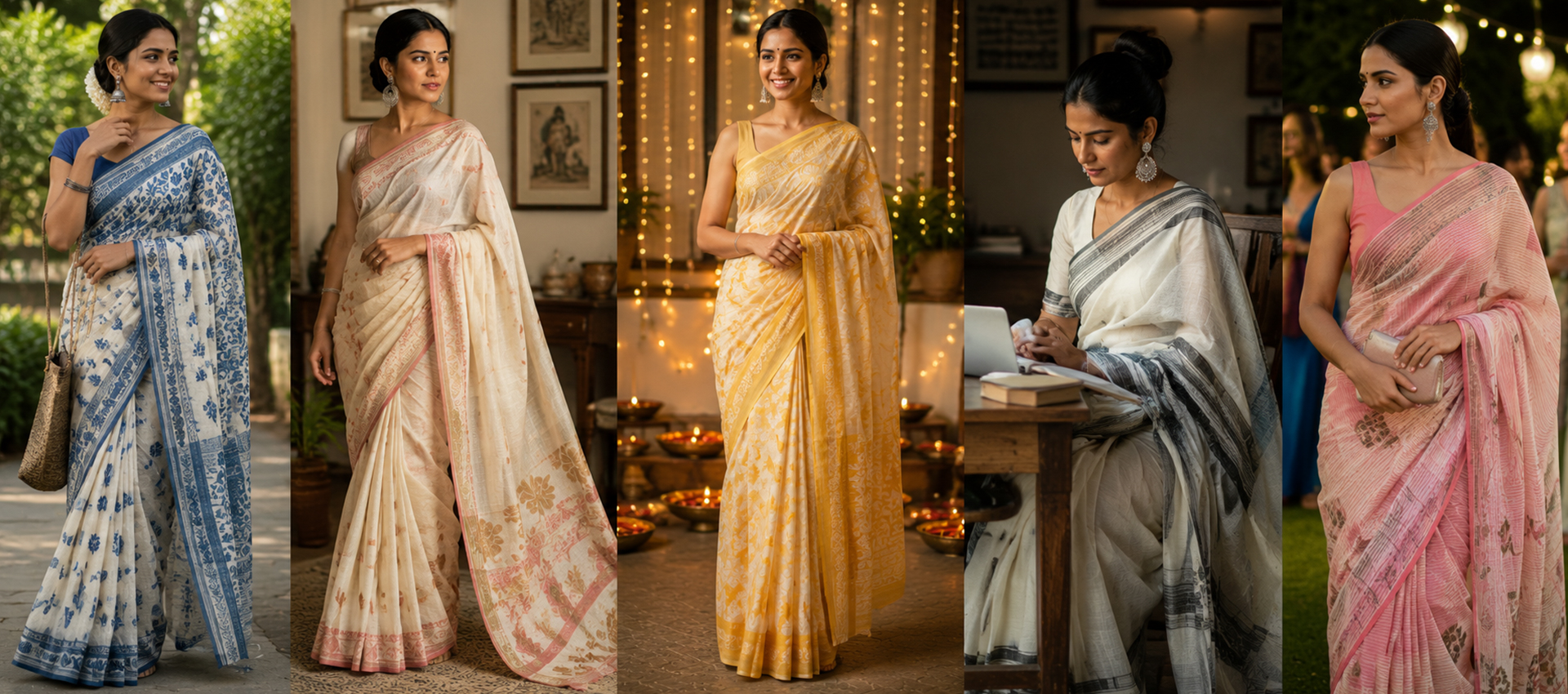
For the office, the key styling principle is crispness. A starched handloom cotton saree — Dhaniakhali, Mangalagiri, or a crisp Kota Doria — with sharp pleats and a well-fitted, structured blouse reads as polished and intentional in any professional environment. Avoid very lightweight, unstarched cottons for the office — they tend to look casual regardless of how they are draped. A slight starch and careful ironing transforms even a simple cotton saree into a garment of professional authority.
The best cotton sarees for work: Dhaniakhali and tant for their natural crispness and clean lines, Mangalagiri with its characteristic double borders for a subtly graphic look, Kota Doria for its open weave and professional lightness in warm weather, and Chanderi cotton — slightly luminous from the cotton-silk blend's sheen — for meetings and presentations where you want to convey considered elegance rather than casual ease. Blouses in solid colours, well-tailored with a modest neckline, are the most versatile professional choice. Jewellery should be restrained — small studs, a simple chain, or a single elegant bangle rather than layered statement pieces.
Office styling formula: Starched handloom cotton (Dhaniakhali / Mangalagiri / Kota) + structured solid blouse + small silver or gold studs + block heel or flat + neat Nivi drape with even pleats. Total effort: 15 minutes. Impact: complete.
Cotton sarees for casual outings: when comfort and style are the same thing
The casual occasion is where cotton sarees are most naturally at home — and where the temptation to under-style them is greatest. The mistake most women make with casual cotton sarees is treating them as afterthoughts: a random drape, a mismatched blouse, minimal thought about accessories. The result is a look that reads as unfinished rather than effortlessly relaxed. Casual dressing in a cotton saree should feel easy, but it should not look accidental.
For weekend outings, cultural events, markets, museum visits, and informal lunches, the most effective approach is the deliberate casual — choosing a cotton saree with an interesting print, weave, or colour, pairing it with a blouse that creates a considered combination rather than a default match, and adding one well-chosen accessory that elevates the whole. A block-printed cotton in indigo or earthy tones with a contrast blouse and a single statement silver necklace is a look of genuine style that requires no more effort than throwing together a generic casual outfit but produces a completely different quality of impression.
The best cotton sarees for casual occasions: Block-printed cottons in natural dye palettes, soft ikat cottons with their distinctive blurred patterns, lightweight Bengali tant in relaxed colours, and linen-cotton blends that drape with natural ease. For casual settings, you can afford to experiment with more interesting blouse choices — a cold-shoulder design, a jacket blouse, a high-neck with contrast piping, or even a simple fitted kurta worn as a top with a casually draped cotton saree. Footwear can be flat — juttis, Kolhapuri chappals, or simple leather sandals all work beautifully with handloom cotton's artisanal character.
"A cotton saree styled with intention is never casual. It is simply the most intelligent version of relaxed dressing — comfortable enough to live in, beautiful enough to be remembered for."
Cotton sarees for festivals and cultural occasions: colour, craft, and celebration
Festivals are where cotton sarees get to show their full range — and where the richness of India's handloom cotton traditions becomes most apparent. Diwali, Durga Puja, Onam, Pongal, Ugadi, Eid — every Indian festival has its own textile traditions and its own colour language, and handloom cotton participates in virtually all of them with indigenous appropriateness.
For Durga Puja, the white-and-red Bengali cotton saree — tant or Dhaniakhali — is not simply a stylistic choice but a cultural statement of the deepest kind. For Onam, a cream or off-white Kerala cotton saree with a golden kasavu border is the traditional festive choice — and its restraint is precisely what makes it beautiful. For Diwali across North India, block-printed or embroidered cottons in festive colours — deep red, emerald, saffron, midnight blue — allow full festive participation without the weight and heat of heavy silk in what is typically still warm-to-mild weather across most of the country.
The key to elevating a cotton saree to full festive status is the blouse and the jewellery — these two elements do more to transform a fabric's register than any other styling variable. A handloom cotton saree paired with a heavily embroidered or zari blouse and significant gold jewellery reads as completely festive, regardless of the fabric's inherent casualness. Conversely, the same cotton saree with a simple blouse and minimal jewellery reads as daytime casual. The cotton itself is neutral with respect to occasion — it is what you add to it that determines where it belongs.
Festival styling formula: Rich-coloured or traditionally appropriate cotton saree + embroidered or zari blouse + gold jewellery (temple jewellery, polki, or antique gold all work beautifully) + traditional footwear. The combination is festive, culturally rooted, and significantly more comfortable through a long day of celebration than any equivalent silk choice.
Cotton sarees for weddings and formal occasions: the case everyone underestimates
This is where the real recalibration needs to happen. The assumption that weddings require silk is so deeply embedded in Indian fashion culture that even women who happily wear cotton everywhere else feel uncertain about it at formal occasions. It is time to examine that assumption carefully — because it is built on habit and social convention rather than any genuine aesthetic logic.
A finely woven Jamdani cotton saree is, by any objective measure, one of the most exquisite textiles in the world. Its patterns are woven thread by thread over days or weeks by master craftspeople whose skill is without parallel. Its appearance — light catching the woven motifs differently from every angle, the gentle translucency of fine cotton, the elegant restraint of its aesthetic — is not less sophisticated than silk. It is differently sophisticated, and that difference is a choice rather than a compromise.
For weddings and formal occasions, the cotton sarees that translate most effectively are those with inherent richness of craft: Jamdani for its woven luxury, Chanderi cotton with its silk warp creating natural luminosity, Maheshwari cotton-silk for its characteristic reversible border and elegant drape, and heavily embroidered or embellished cottons where the work on the fabric surface creates the formal register that plain weaves cannot. Heavy blouses — in brocade, in embroidery, in raw silk with embellishment — do the most work in elevating cotton to formal occasion status. And jewellery at the wedding weight — significant pieces in gold, temple jewellery, polki, or heritage pieces — closes the gap between festive cotton and festive silk entirely.
Women who have worn Jamdani or Chanderi cotton to weddings almost universally report the same two experiences: extraordinary comfort through a day that can last eight to twelve hours, and an unusual number of compliments from guests who have never seen that specific combination before. Standing out at an Indian wedding, where silk sarees are ubiquitous, by wearing the most beautiful handloom cotton in the room is not a fashion risk. It is a fashion statement.
For weddings: the cotton elevation checklist. Choose: Jamdani, Chanderi cotton, or Maheshwari. Blouse: heavily embroidered, brocade, or zari. Jewellery: wedding-weight gold or polki. Drape: Nivi with perfect pleats, pinned securely. Footwear: heels or embellished flats. Result: the most memorable look in the room — and the most comfortable woman wearing it.
Cotton sarees for travel: the most practical luxury in your suitcase
Travel is the occasion that reveals the true advantage of cotton sarees over every alternative. A handloom cotton saree packed into a suitcase — rolled rather than folded to minimise creasing — arrives at its destination ready to shake out and wear after minimal steaming or overnight hanging. It washes easily in a hotel sink if needed, dries within a few hours, and performs across whatever the day demands — sightseeing, formal meetings, cultural visits, evening dinners — with a single change of blouse and jewellery doing the work of an outfit change.
The cotton saree traveller's packing formula is one of Indian fashion's most elegant solutions: two or three cotton sarees in versatile colours, four blouses that mix across them in different combinations, two sets of jewellery — one casual, one elevated — and a single pair of comfortable but presentable footwear. That is a week of genuinely varied, always appropriate, always personal dressing in less space than a standard carry-on requires for conventional Western travel wardrobes.
For travel specifically, choose lighter-weight cottons — Kota Doria, fine tant, or soft linen-cotton blends — that pack most compactly and recover most quickly from the compression of a suitcase. Darker colours and prints are more forgiving of the minor travel marks and dust that pale sarees would show. A simple clip-on blouse hook or two extra safety pins weigh nothing and are the difference between a confident all-day drape and the quiet anxiety of a saree that needs attention every hour.
The golden rules of cotton saree styling — across every occasion
Across every occasion and every cotton saree type, a handful of styling principles apply consistently and reliably. The first is that the blouse is always the most powerful variable — a well-fitted, appropriately chosen blouse transforms a cotton saree's occasion register more effectively than any other single element. Invest as much thought and budget in your blouses as in the sarees themselves.
The second rule is that accessories should be chosen from the same aesthetic register as the saree's craft tradition. A block-printed cotton pairs best with handcrafted artisan jewellery — oxidised silver, dhokra, natural stone pieces. A Jamdani or Chanderi pairs best with heritage jewellery in gold or silver. Mixing a rustic handprint cotton with fine diamond jewellery, or a formal Jamdani with chunky boho accessories, creates a visual dissonance that neither the saree nor the jewellery deserves.
The third rule — and the most important — is confidence. A cotton saree worn with complete conviction in any setting reads as a deliberate choice rather than a compromise. The women who make cotton sarees look extraordinary at every occasion are not wearing different sarees from anyone else — they are wearing their sarees differently. They have decided that what they are wearing is exactly right, and that decision is visible in how they carry themselves. No styling tip, no blouse choice, and no jewellery selection is as powerful as that.
Antarang's handloom cotton saree collection spans every occasion — from daily Dhaniakhali to occasion-worthy Jamdani and Chanderi. Every piece is sourced directly from master weavers and priced honestly. Find your next cotton saree here.
Shop cotton sarees for every occasion →