
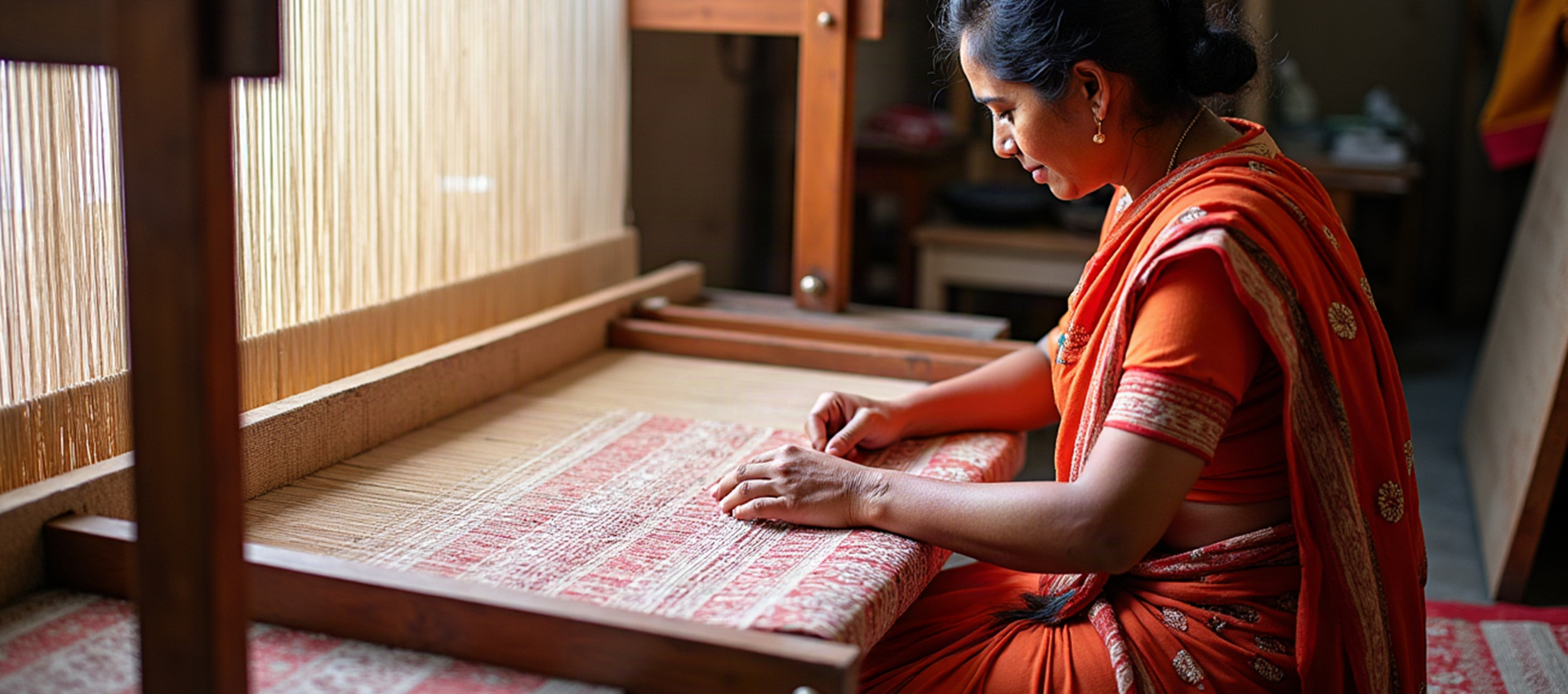
There is something deeply satisfying about knowing how a saree was made. The moment you understand that a pattern was not printed onto the fabric but patiently built thread by thread, that a motif was created by individually inserting extra-weft yarn, or that the colours in an Ikat saree were planned before the yarn even reached the loom, the saree begins to look different. You stop seeing only colour and design. You begin to see the hands, skill, decisions and time behind it. India's handloom heritage is extraordinary precisely because there is no single way of weaving an Indian textile.
The looms, yarns, motifs, techniques and finishing methods change dramatically from one region to another. Government handloom documentation describes how India's different weaving regions have their own equipment, materials, patterns, textures and colours, passed down through generations. From Kanjeevaram and Banarasi to Paithani, Ikat, Chanderi, Maheshwari and Jamdani, each represents a different chapter of India's textile story. But what exactly are these traditional Indian weaving techniques? And why do two handwoven sarees made in completely different parts of India look and feel so different? Let's take a closer look.
Jamdani is one of India's most delicate and labour-intensive weaving traditions. Traditionally associated with fine muslin and Bengal, its beauty lies in the way individual motifs are created using extra-weft threads over a plain-weave ground.
The weaver works each motif separately, often using small bamboo sticks and individual spools of thread, following a design placed beneath the warp. Floral, geometric and plant-inspired motifs seem to float across the fabric, creating the almost weightless appearance for which Jamdani is loved. The result is a textile where the craftsmanship is easy to miss from a distance but extraordinary once you look closely.
Ikat is fascinating because the design begins before the fabric exists. In this technique, sections of the yarn are carefully tied and resist-dyed according to the desired pattern. Once the dyed yarns are arranged on the loom, the colours and patterns gradually align to create the final design. India has important Ikat traditions in regions including Odisha and Andhra Pradesh/Telangana.
The characteristic slightly blurred or feathered edges of many Ikat motifs are not imperfections to be corrected; they are part of the visual identity of the technique. In other words, with Ikat, the weaver is planning the design at the yarn stage.
If you appreciate intricate Banarasi sarees, Kadhwa is a technique worth knowing. Kadhwa, also written as Kadwa or Kardhwan in different contexts, uses extra-weft weaving to create individual motifs. Rather than relying simply on long floating threads across the back of the fabric, the decorative elements are worked into the textile motif by motif. This makes Kadhwa particularly suited to intricate butis, floral patterns and elaborate brocades. It is also highly labour-intensive, which is one reason finely woven Kadhwa Banarasis are valued by serious saree collectors.
The beauty is not only on the front. Turn the saree over and the structure of the weaving can reveal clues about how the motif was constructed.
Brocade is a decorative weaving tradition in which additional yarns are introduced to create elaborate motifs and figured surfaces. Banarasi brocade is perhaps India's most famous example. Silk and zari come together to create floral, foliate and geometric patterns, producing the unmistakable richness associated with Banarasi sarees. But brocade is not exclusive to Banaras.
Different Indian weaving centres have developed their own interpretations, materials and design vocabularies. Government documentation itself notes that brocade weaving techniques differ across regions. That is an important reminder: the word brocade describes a weaving approach, not one single saree.
Jacquard is frequently misunderstood as synonymous with machine weaving. It isn't. A Jacquard mechanism controls selected warp threads so that complex figured designs can be woven into fabric. It can be used on different kinds of looms, including handlooms equipped with Jacquard attachments. That distinction matters because a Jacquard handloom saree can still be handwoven.
Jacquard tells us about the mechanism used to create the design; it does not, by itself, tell us whether the loom is hand-operated or power-operated. The Government of India's handloom system itself recognises technological interventions including dobby and Jacquard, with Weavers' Service Centres providing training in these areas.
Dobby is another mechanism used to control warp threads and create patterned fabrics. It is particularly useful for repeated geometric or smaller figured designs that require more control than a basic plain weave but do not necessarily require the extensive patterning capability of a Jacquard.
Dobby and Jacquard are therefore not simply “machine-made” techniques. They are tools that expand what a loom can create. This is a good example of why textile terminology deserves more nuance than we often give it.
Jala is closely associated with traditional Banarasi weaving and the creation of complex figured patterns. Historically, the jala system allowed weavers to control groups of warp threads according to an intricate design, enabling elaborate floral and jaal patterns to be woven into the saree.
It represents the extraordinary design planning that existed within traditional Indian weaving long before today's digital textile technology.
Jamawar is associated particularly with Kashmir and the tradition of richly patterned woven textiles. Historically used for shawls and other luxury textiles, Jamawar weaving is known for dense, intricate patterns and elaborate colour combinations.
The technique demonstrates another important characteristic of Indian textile heritage: weaving was not simply about producing clothing. Highly skilled weaving could create textiles that functioned almost like works of art.
Kani weaving is another remarkable Kashmiri tradition, especially associated with intricately patterned shawls. Small wooden sticks or bobbins known as kanis are used to introduce coloured threads according to the design.
The process allows the weaver to build extraordinarily detailed patterns across the textile. The technique is slow and highly skilled, which makes the finished textile feel fundamentally different from a mass-produced patterned fabric.
Extra-weft techniques appear repeatedly across India's textile traditions, although the specific methods and visual results differ. Instead of the decorative pattern being produced only by the regular weft, additional threads are introduced selectively to create motifs. Jamdani is one of the clearest examples, while various brocade traditions also use supplementary weft structures.
This is one of those technical details that explains why a handwoven saree can have such extraordinary dimensionality. The motif is not simply sitting on top of the fabric. It is part of the architecture of the weave.
Not every beautiful Indian handloom textile depends on elaborate patterning. Plain weave is one of the simplest structures, created by passing the weft over and under successive warp threads. Yet some of India's most beautiful everyday sarees use variations of this fundamental structure. The beauty may instead come from the yarn, colour, fineness, texture, borders or the subtle irregularities created by handweaving.
This is particularly important when appreciating cotton sarees. A simple weave can demand extraordinary skill when the yarn is fine, the fabric is lightweight and the finish needs to be precise.
Perhaps the most important “technique” of all is the way Indian weaving traditions have evolved around their regions. Kanjeevaram silk from Tamil Nadu, Banarasi brocade from Varanasi, Paithani from Maharashtra, Muga silk from Assam, Ikat from Odisha and Andhra Pradesh, Kullu shawls from Himachal Pradesh, Kani and Pashmina from Kashmir, Chanderi and Maheshwari from Madhya Pradesh—the list goes on.
Each developed within its own social, cultural and geographical environment. Climate influenced fibres. Local availability influenced materials. Communities developed specialised skills. Royal patronage shaped some traditions, while everyday needs shaped others. That is why Indian handloom cannot really be understood as one category. It is a collection of living traditions.
For a saree lover, learning these techniques changes the shopping experience completely. You begin to understand why one saree is airy while another has structure, why one motif appears slightly blurred while another is incredibly precise, why a particular Banarasi is significantly more labour-intensive, or why two sarees that look similar in photographs can have completely different values.
More importantly, you begin to distinguish design from craftsmanship. A printed floral saree can reproduce a motif instantly. A handwoven floral motif may require the weaver to construct that design through thousands of carefully controlled threads. That difference is invisible if we look only at the finished picture. It becomes visible when we understand the craft.
There is sometimes an assumption that preserving handloom means refusing technology. The reality is more interesting. India's handloom sector continues to incorporate design development, technological interventions, training and new approaches while retaining the manual nature of handloom production.
The Development Commissioner for Handlooms specifically supports technological training, design inputs and productivity improvements for weaving communities. Tradition, after all, survives not because it refuses to change, but because it continues to have meaning.
The next time you look at a saree, look beyond the colour. Ask yourself: How was this pattern created? Was the yarn dyed before weaving? Were the motifs added individually? What kind of loom was used? What makes this textile different from another one that looks similar? Those questions take you much deeper into India's textile heritage. And perhaps that is the most beautiful part of handloom. The more you learn, the more there is to see.
At Antarang, we believe that a saree becomes even more special when you understand the craft behind it. Our journey through Indian textiles is about discovering these regional weaving traditions, appreciating the people who keep them alive, and bringing that extraordinary craftsmanship into the wardrobes of modern women. Explore our collection of handwoven Indian sarees and discover the stories woven into every drape.
The Complete Guide to Banarasi Sarees: 10 Types Every Saree Lover Should Know
September 28th, 2026
11 Fascinating Facts About Banarasi Sarees You Probably Never Knew
September 24th, 2026
Real vs Fake Banarasi Saree: 9 Ways to Spot Authentic Handloom Weaving
September 17th, 2026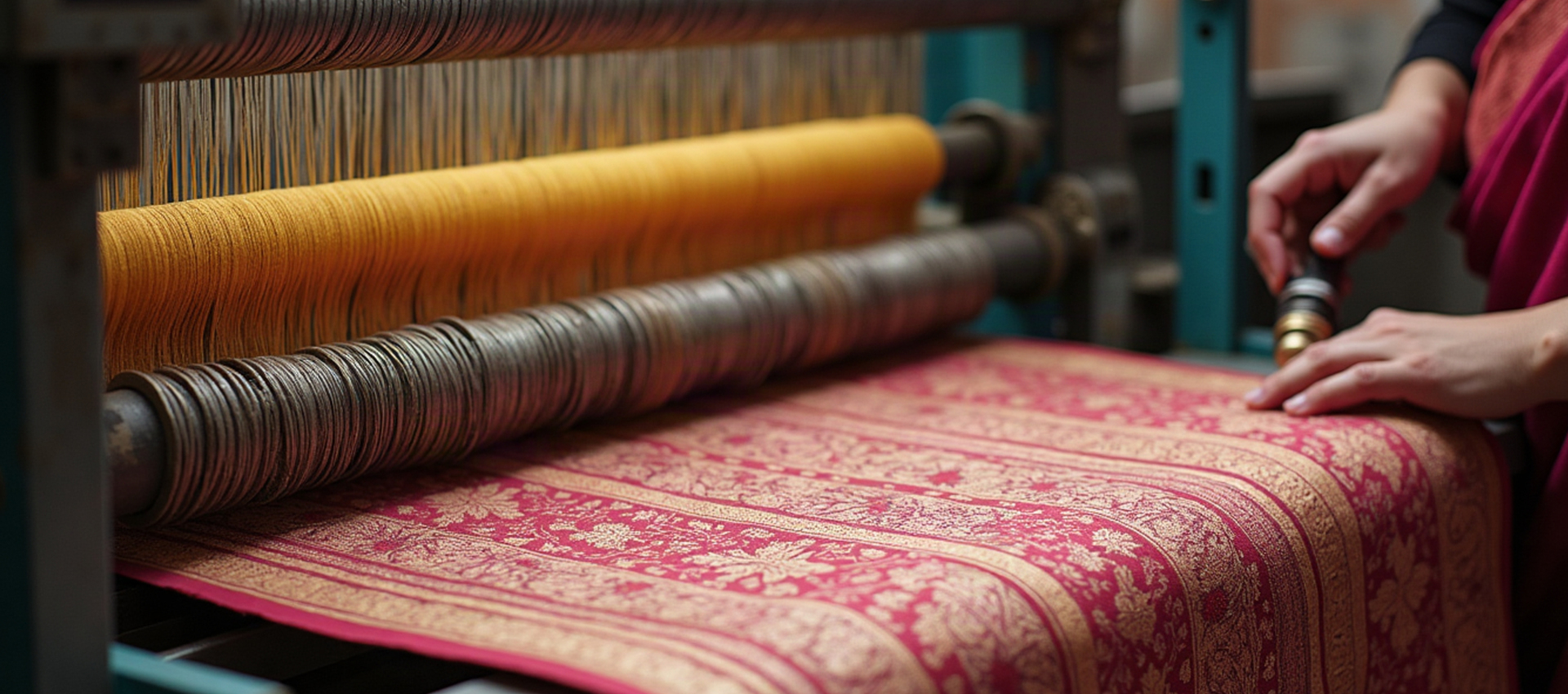
Jacquard Weaving Explained: Why Jacquard Does NOT Mean Powerloom
September 10th, 2026
The Origin of Linen Sarees in India: From Ancient Flax to Handloom
September 2nd, 2026