There is a sentence we hear surprisingly often in the world of sarees: “It is Jacquard, so it must be powerloom.” It sounds convincing. It is also incorrect. The confusion comes from the fact that Jacquard and powerloom are both words associated with textile machinery, and they are sometimes used casually to describe woven sarees. But they actually refer to two completely different things.
A Jacquard is a mechanism used to control the lifting of warp threads and create intricate woven designs. A powerloom is a loom operated mechanically using power. A Jacquard mechanism can be fitted to a handloom, and government textile documentation specifically describes handlooms with Jacquard attachments. Understanding this distinction is important, particularly if you care about handwoven sarees. It can help you ask better questions, understand what you are buying and, most importantly, stop judging a saree's authenticity simply because you see the word “Jacquard” attached to it.
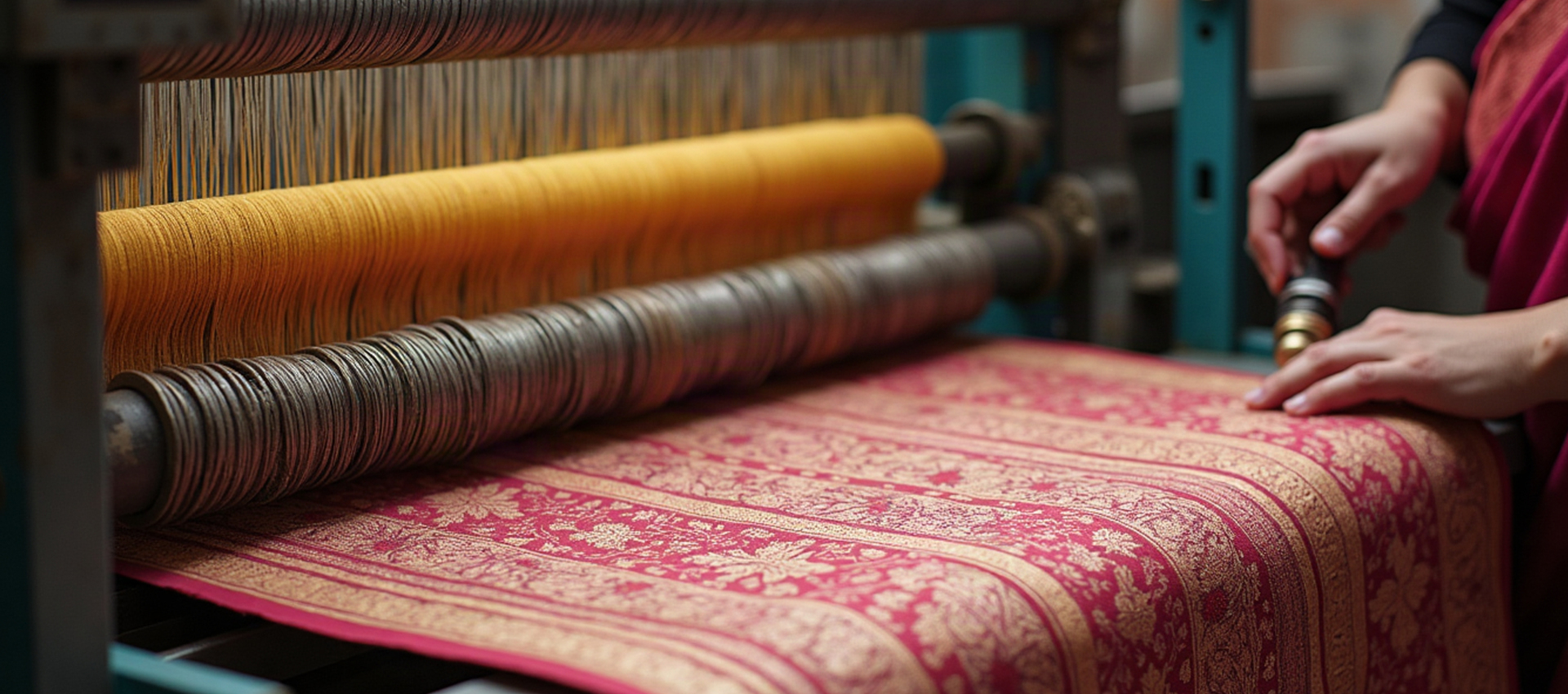
At its simplest, Jacquard weaving is a method of controlling individual warp threads to create complex patterns in woven fabric. Traditional looms are perfectly capable of creating stripes, checks and simpler repeated patterns. But when the design becomes more complicated—with intricate floral motifs, large figured patterns, elaborate jaals or detailed brocade—the weaver needs greater control over which warp threads are raised and when. That is where the Jacquard mechanism comes in.
Government textile training material describes a Jacquard as a shedding device used for designs beyond the scope of simpler dobby shedding, particularly large and intricate figured designs involving hundreds or even thousands of warp ends. In other words, Jacquard is fundamentally about design capability. It is not, by itself, a statement about whether the loom is powered by electricity or operated manually.
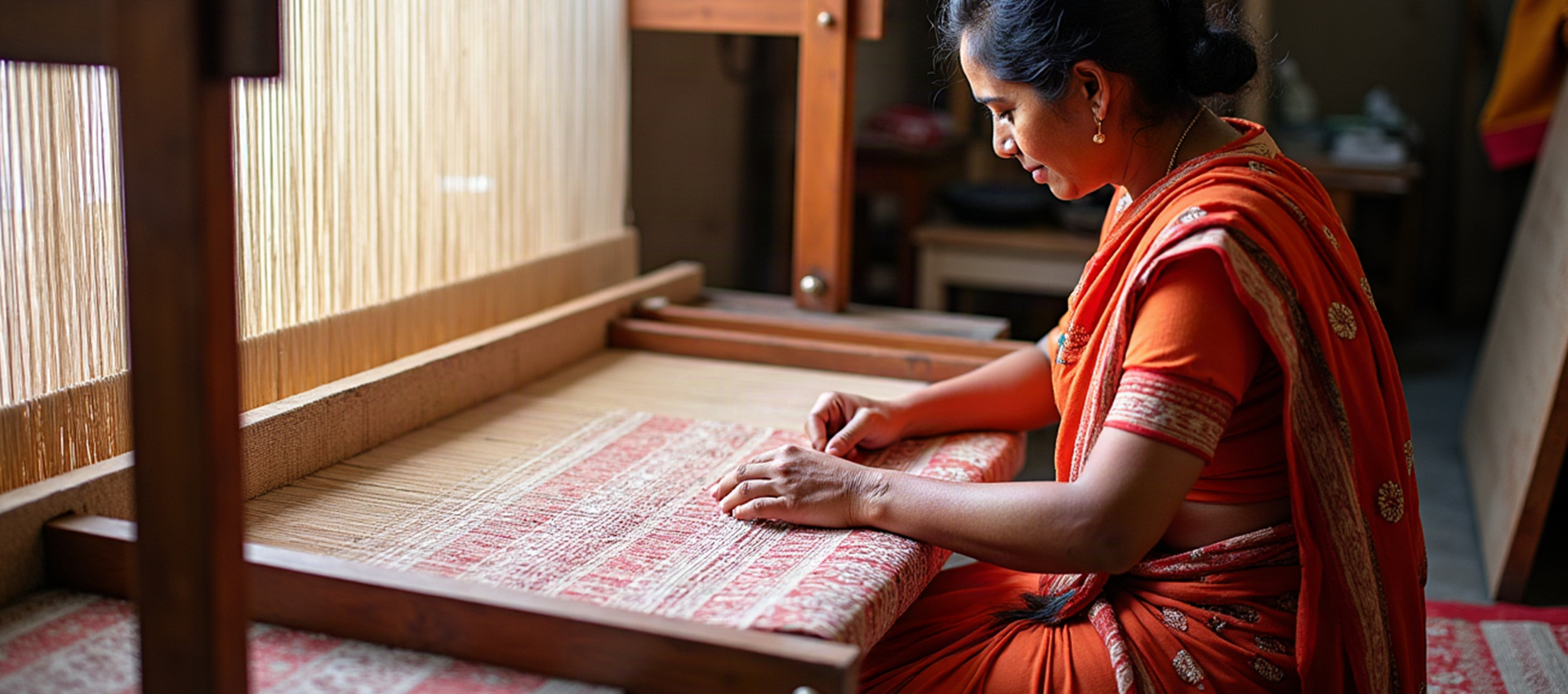
A powerloom is different because the defining feature is the source of power used to operate the loom. In a powerloom, mechanical or electrical power drives the weaving motions. This allows production to be faster and more mechanised. A handloom, on the other hand, is manually operated by the weaver. Government textile documentation describes handloom weaving as a manual operating system, with operations such as shedding, picking and beating carried out through manual mechanisms depending on the type of loom.
This gives us a very simple distinction: Jacquard = how complex woven designs are controlled. Powerloom = how the loom is operated. Once you understand that difference, much of the confusion disappears.
Yes. And this is the part that many saree shoppers don't know. A handloom can be fitted with a Jacquard attachment to enable the weaver to create more complicated woven designs. The Third All India Handloom Census documentation specifically identifies frame looms with dobby/Jacquard attachments, noting that these can produce embroidered or figured handwoven fabrics such as sarees.
The Government of India's Development Commissioner (Handlooms) also works with weaving technologies including dobby and Jacquard, and government programmes have supported technological upgrades such as electronic Jacquards for handloom weavers.
So seeing a Jacquard mechanism on a loom should not immediately make you conclude that the saree is powerloom. The loom and its method of operation still matter.
Think of a saree covered with an intricate floral jaal. The design may require different groups of warp threads to rise and fall in very specific combinations as the weft passes through. The more complicated the design, the more control is required.
A Jacquard mechanism makes this possible by controlling the warp threads according to the pattern being woven. That is why Jacquard weaving is commonly associated with figured textiles, elaborate floral patterns, brocades and other detailed designs. The mechanism does not “print” the design onto the saree.
The design is woven into the fabric. That distinction is important. A woven motif is structurally part of the textile. It is created through the interaction of warp and weft threads rather than being added afterwards as a surface print.
Not necessarily. This is perhaps the biggest misconception of all. A saree can be handwoven using a Jacquard attachment. It can also be produced on a mechanically operated loom using Jacquard technology.
The presence of Jacquard technology alone does not tell you which one it is. If you want to know whether a particular saree is handwoven, you need to look at the loom, production process, fabric characteristics and credible authenticity information, rather than treating the word “Jacquard” as the answer.
This is particularly relevant when shopping online, where product descriptions can sometimes use technical textile terminology very loosely.
Part of the confusion is visual. A modern Jacquard mechanism can look highly technical and mechanical, and some Jacquard looms are indeed used in powerloom production.
Meanwhile, handlooms fitted with Jacquard attachments may also look quite sophisticated compared with the simple wooden looms people traditionally imagine when they hear the word “handloom”. There is another reason: Jacquard designs can be reproduced mechanically at scale.
Once a particular design can be programmed or translated into a mechanical or electronic system, similar-looking patterns can be produced much faster on power-operated machinery. The finished sarees may look remarkably similar at first glance. But the fact that two sarees share a similar design does not mean they were made in the same way.
If textile terminology makes your head spin, remember this simple framework. A handloom tells you about the way the loom is operated. A powerloom tells you that the weaving is mechanically powered. A Jacquard tells you about a mechanism for controlling warp threads to create complex figured designs.
These terms can therefore overlap. A saree can be handwoven on a handloom with a Jacquard attachment. Another saree can be woven on a powerloom using Jacquard technology. The word Jacquard by itself cannot tell you which one you are looking at.
No. Technology and craftsmanship are not necessarily opposites. Handloom traditions have always evolved. New tools and technological interventions can help artisans reduce repetitive labour, improve productivity and create more complex designs while retaining manual weaving processes.
The Government of India's handloom ecosystem itself recognises Jacquard technology as one of the technological areas in which weavers receive training and support. The important question is not simply, “Does this saree use Jacquard?” The better question is: “How was this saree actually woven?” That is the question a knowledgeable saree buyer should be asking.
Instead of asking only whether a saree is Jacquard, ask the seller a few more specific questions. Was the saree woven on a handloom or powerloom? What type of loom was used? Is the Jacquard mechanical, electronic or another type of attachment? What is the fabric composition? Who or where was it woven? Is there a Handloom Mark or other credible documentation where applicable? These questions are much more useful than simply asking, “Is it Jacquard?” Because Jacquard is not the opposite of handloom. It is a weaving technology.
The more you learn about textiles, the more you realise that a saree's story cannot be reduced to a single word on a product label. Handloom is not simply about an old-fashioned wooden loom. Jacquard does not automatically mean machine-made.
And an intricate design does not automatically tell you how the fabric was produced. The real story lies in the relationship between the loom, the technology, the weaver, the yarn and the process. And that is precisely why learning about weaving makes buying sarees so much more rewarding.
The next time someone tells you, “Jacquard means powerloom,” you will know there is a much more interesting story behind those two words.
At Antarang, we believe that knowing the story behind a saree makes wearing it even more meaningful. Explore our thoughtfully curated collection of Indian handlooms and handcrafted sarees, where the beauty of the textile begins with understanding the craft behind it.
The Complete Guide to Banarasi Sarees: 10 Types Every Saree Lover Should Know
September 28th, 2026
11 Fascinating Facts About Banarasi Sarees You Probably Never Knew
September 24th, 2026
Real vs Fake Banarasi Saree: 9 Ways to Spot Authentic Handloom Weaving
September 17th, 2026
The Origin of Linen Sarees in India: From Ancient Flax to Handloom
September 2nd, 2026