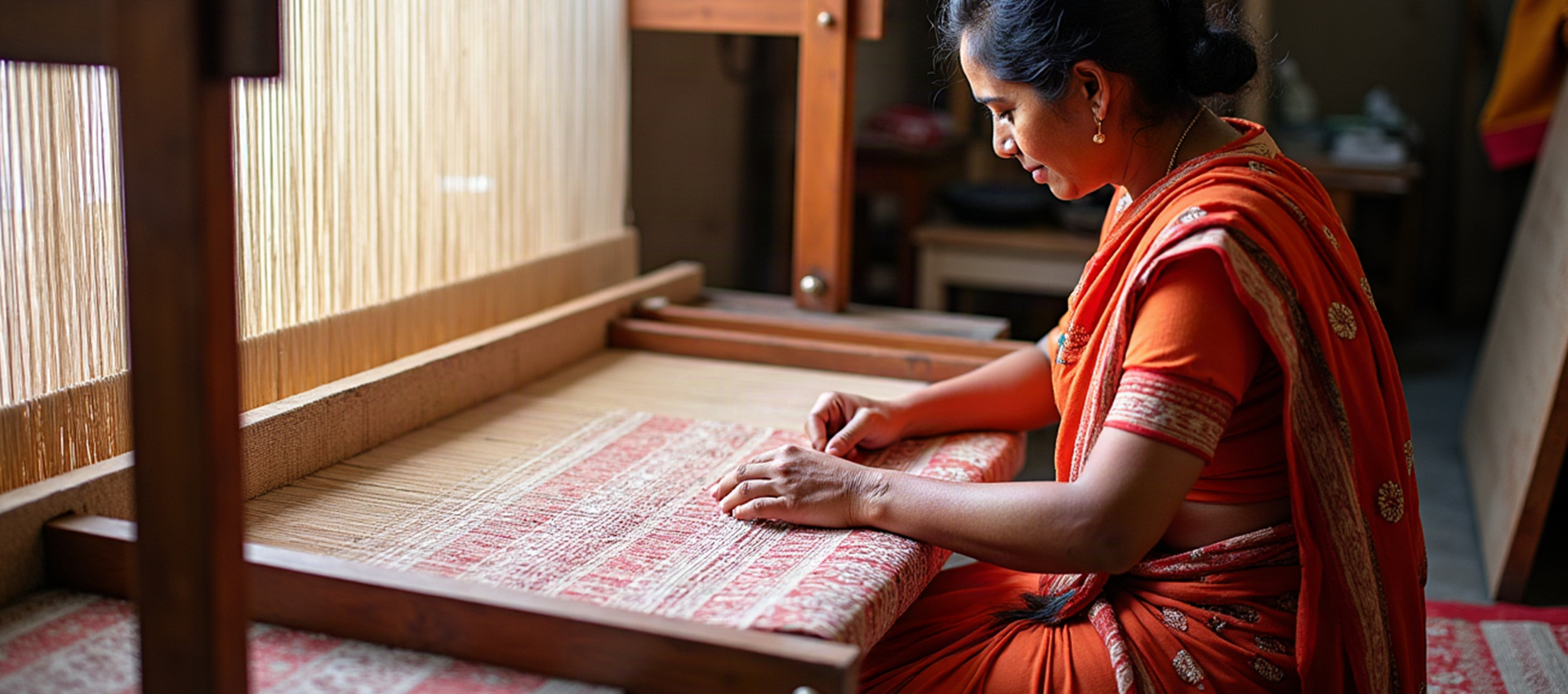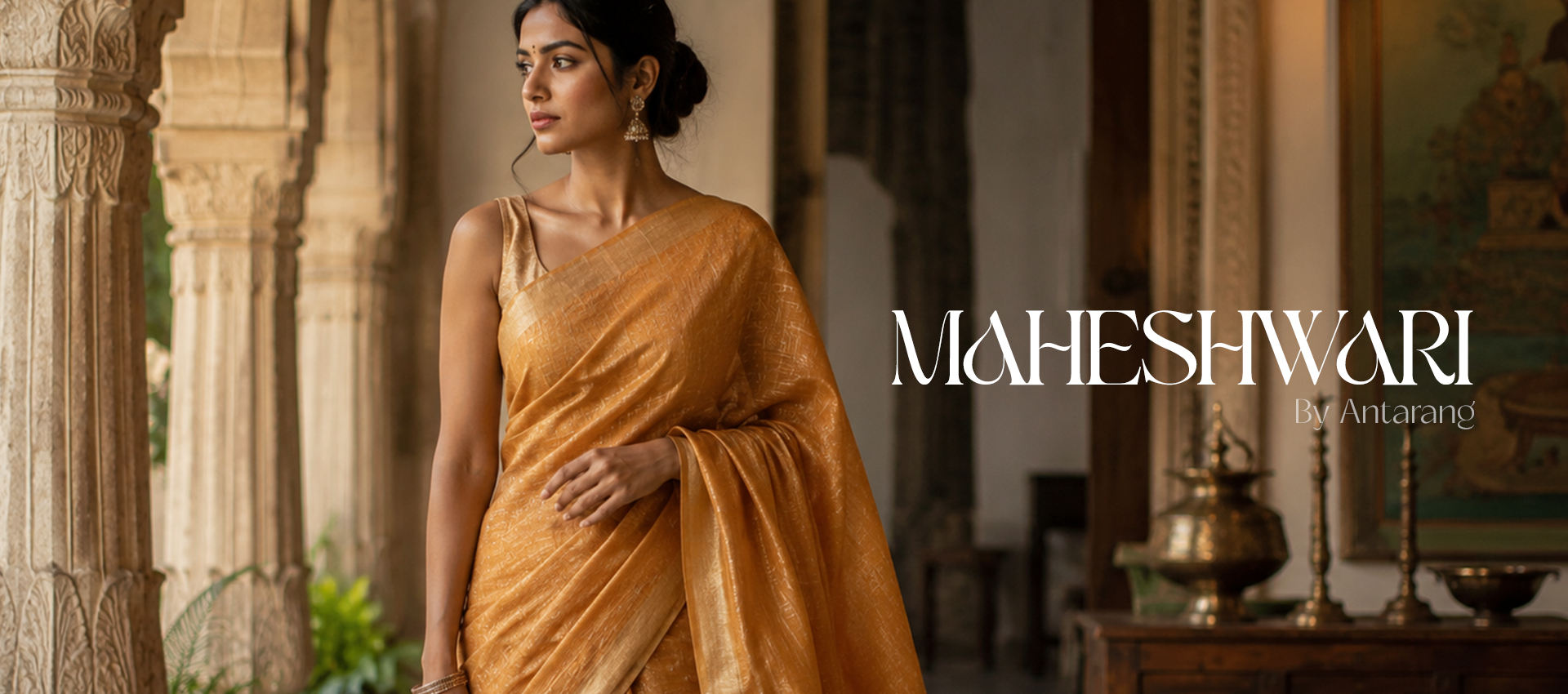
There are some Indian textiles that are beautiful because of their colours, some because of their intricate craftsmanship, and some because of the story they carry. The Maheshwari saree belongs to the last category as much as it belongs to the first two. Light, elegant and unmistakably graceful, the handwoven Maheshwari silk saree carries with it a story of royalty, craftsmanship and a remarkable woman who transformed the textile tradition of a small town in Madhya Pradesh. To understand the origin of the Maheshwari saree, we need to travel to Maheshwar, a historic town situated on the banks of the Narmada River in Madhya Pradesh. The town is famous for its magnificent fort, temples, ghats and centuries-old cultural heritage, but it is equally important for the weaving tradition that developed under the patronage of Ahilyabai Holkar, the celebrated queen of the Holkar dynasty. The Maheshwari saree that we know today is the result of this fascinating meeting of royal patronage, skilled weaving and generations of craftsmanship.
The origin of the Maheshwari saree can be traced to the town of Maheshwar in Madhya Pradesh. Maheshwar has a long history as an important cultural and religious centre, but its connection with handloom weaving became particularly significant during the reign of Queen Ahilyabai Holkar in the eighteenth century.
Ahilyabai Holkar moved her capital from Indore to Maheshwar in 1767 and played a significant role in developing the town as a centre of culture, architecture, trade and craftsmanship. She commissioned temples and public works and encouraged skilled artisans and craftspeople to settle in Maheshwar. Among these were weavers who helped establish the textile tradition that would eventually become synonymous with the town. According to traditional accounts, Ahilyabai Holkar invited weavers from different parts of India, including Surat and Mandu, to Maheshwar.
These skilled artisans were encouraged to create fine textiles suitable for the royal household and its patrons. Over time, their techniques and designs evolved into what we now recognise as the Maheshwari handloom saree. This connection with Ahilyabai Holkar is central to the story of the Maheshwari saree. It is not simply a textile that happened to emerge from Maheshwar; it is a craft tradition that grew with the town's royal and cultural development.
The earliest Maheshwari textiles were created with royalty in mind. The sarees and fabrics produced by the weavers of Maheshwar were known for their fine quality, lightness and elegant appearance. The royal connection gave the artisans an environment where they could experiment with weaving techniques, yarns, colours and motifs.
This period laid the foundation for the distinctive character of Maheshwari sarees. Rather than relying on heavy embellishment, the textile developed its identity through its weave, fine borders, geometric patterns and understated elegance. The influence of Maheshwar's architecture and surroundings can also be seen in traditional Maheshwari designs. Motifs inspired by local temples, architectural forms and the natural environment became part of the weaving vocabulary.
Traditional patterns such as stripes, checks and geometric designs continue to be associated with Maheshwari sarees. One of the most recognisable elements is the Maheshwari border, often featuring distinctive geometric patterns and zari work. The pallu can also feature stripes and traditional motifs that give the saree its characteristic appearance.
A handwoven Maheshwari silk saree is known for being lightweight, comfortable and elegant. Traditionally, Maheshwari sarees have been woven using silk and cotton, although variations in yarn combinations exist today. The classic silk-cotton structure gives the saree a beautiful balance. Silk contributes to its subtle sheen and graceful fall, while cotton adds a certain lightness and breathability. This combination is one of the reasons Maheshwari sarees are so versatile.
A genuine handwoven Maheshwari saree also carries the small variations that are natural to handmade textiles. The texture, weave and slight irregularities are not imperfections; they are evidence that the saree has passed through a human hand and a loom rather than an automated production line. The weaving process itself requires skill and patience. The artisan must manage the warp and weft carefully while creating the border, body and pallu. Zari may be incorporated into the design, adding a subtle shimmer without overwhelming the delicacy of the fabric.
This understated quality is one of the reasons Maheshwari silk sarees have remained relevant for generations.
Maheshwari sarees have developed a distinctive design vocabulary that makes them relatively easy to recognise. Traditional designs often include stripes, checks, geometric patterns and delicate zari borders. Some sarees feature motifs inspired by the architecture of Maheshwar, including patterns associated with the town's temples and fort. The pallu is another important feature. Traditional Maheshwari pallus often have stripes or geometric arrangements that create a clean and sophisticated finish.
The borders may feature zari detailing, sometimes with designs inspired by local architectural elements. The beauty of these designs lies in their restraint. Maheshwari is not about overwhelming the wearer with decoration. Instead, it creates visual interest through proportion, texture, colour and the relationship between the body of the saree and its border. This makes a Maheshwari saree equally comfortable in a festive setting, an office wardrobe or a more intimate occasion.
It is impossible to talk about Maheshwar without mentioning the Narmada River. The river is deeply connected with the town's cultural and spiritual identity, and its presence forms an important part of the visual landscape surrounding the weaving community.
The ghats of Maheshwar, the historic fort and the temples create an environment where history and everyday life exist side by side. For generations, weaving has been part of that everyday life. This connection between place and craft is what makes geographical handloom traditions so special.
A Maheshwari saree is not simply named after Maheshwar. Its identity has been shaped by the history, culture and communities of the town itself.
Like many Indian handloom traditions, Maheshwari weaving has had to navigate enormous changes in the textile industry. The growth of mechanised manufacturing, changing consumer preferences and competition from cheaper fabrics created challenges for traditional weavers. Yet the craft survived because weaving knowledge continued to be passed from one generation to another. In the twentieth century, organisations and individuals played important roles in reviving and supporting Maheshwari handloom.
One of the most significant developments was the establishment of Rehwa Society in 1979, which was founded with the objective of supporting Maheshwar's weaving community and helping preserve the traditional craft. Such initiatives helped provide employment and stability for weavers while also encouraging the continued production of authentic Maheshwari textiles. The story is important because the survival of a handloom is ultimately dependent on the survival of its weaving community. A technique can be centuries old, but if artisans cannot earn a sustainable livelihood from it, the tradition becomes increasingly difficult to preserve.
The beauty of Maheshwari is that it has successfully travelled from royal courts into contemporary wardrobes without losing its identity. Today's women are increasingly looking for sarees that are elegant but practical, traditional but not overly heavy. Maheshwari silk fits naturally into this space. Its lightweight feel, subtle sheen and clean design make it suitable for everything from everyday dressing and workwear to festive occasions.
A handwoven Maheshwari saree can be styled with a traditional blouse and jewellery for a classic look or paired with a contemporary blouse for a more modern interpretation. Its versatility is one of the reasons it continues to attract women who want to incorporate Indian handloom into their everyday lives. More importantly, wearing a Maheshwari saree today is a way of keeping the story of the craft alive. Every time someone chooses handwoven over mass-produced, it creates demand for the skills and communities that sustain the tradition.
There is a growing appreciation today for textiles that have a story behind them. Consumers are becoming more conscious about craftsmanship, sustainability and the people involved in making their clothes. This has brought Indian handloom traditions back into conversations about slow fashion and responsible consumption.
A handwoven Maheshwari silk saree represents hours of skilled work, traditional knowledge and a connection to a specific weaving community. The price of such a saree therefore reflects much more than the cost of yarn.It represents the time, expertise and human effort involved in creating it. This is also why small variations in a handloom saree should be appreciated rather than treated as flaws. They are part of the individuality of handmade textiles.
Perhaps the most remarkable part of the Maheshwari saree's story is that a decision made by a queen more than two centuries ago continues to influence Indian fashion today. Ahilyabai Holkar's vision for Maheshwar created an environment where artisans could work, live and develop their craft. The weaving tradition that emerged from that period has survived political changes, industrialisation and changing fashion trends.
Today, when a woman wears a Maheshwari silk saree, she is wearing more than an elegant handloom. She is carrying a small piece of Maheshwar's history with her. The river, the fort, the temples, the weaver and the loom are all part of the story.
The origin of the handwoven Maheshwari silk saree is ultimately a story about the power of place and people. Born in the historic town of Maheshwar under the patronage of Ahilyabai Holkar, refined by generations of skilled weavers and carried into contemporary wardrobes, Maheshwari remains one of India's most elegant handloom traditions. Its beauty lies not only in its silk, cotton, zari or distinctive borders. Its true beauty lies in the fact that the tradition is still alive.
At Antarang, we believe Indian handloom deserves to be understood as much as it deserves to be worn. We curate handwoven sarees that connect contemporary women with the remarkable textile traditions of India, while celebrating the artisans and communities who keep these crafts alive. If the story of Maheshwari has made you look at this saree a little differently, explore our collection of handwoven sarees at Antarang and discover the beauty of Indian craftsmanship for yourself.
Because when you choose a handwoven Maheshwari saree, you are not simply choosing a saree. You are choosing a piece of Maheshwar's living history.
The Complete Guide to Banarasi Sarees: 10 Types Every Saree Lover Should Know
September 28th, 2026
11 Fascinating Facts About Banarasi Sarees You Probably Never Knew
September 24th, 2026
Real vs Fake Banarasi Saree: 9 Ways to Spot Authentic Handloom Weaving
September 17th, 2026
Jacquard Weaving Explained: Why Jacquard Does NOT Mean Powerloom
September 10th, 2026